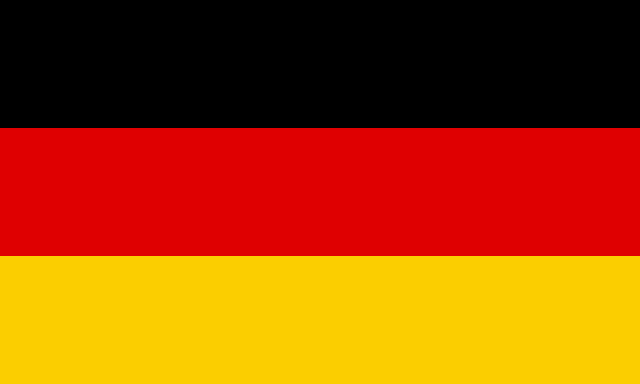
flag — Germany
Nation by Nation
Germany
Government
Government
conventional long form: Federal Republic of Germany
conventional short form: Germany
local long form: Bundesrepublik Deutschland
local short form: Deutschland
former: German Reich
etymology: the Gauls (Celts) of Western Europe may have referred to the newly arriving Germanic tribes who settled in neighboring areas east of the Rhine during the first centuries B.C. as "Germani," a term the Romans adopted as "Germania"; the native designation "Deutsch" comes from the Old High German "diutisc" meaning "of the people"
Government type federal parliamentary republic
Capital name: Berlin
geographic coordinates: 52 31 N, 13 24 E
time difference: UTC+1 (6 hours ahead of Washington, DC, during Standard Time)
daylight saving time: +1hr, begins last Sunday in March; ends last Sunday in October
etymology: the origin of the name is unclear but may be related to the old West Slavic (Polabian) word "berl" or "birl," meaning "swamp"
Administrative divisions 16 states (Laender, singular - Land); Baden-Wuerttemberg, Bayern (Bavaria), Berlin, Brandenburg, Bremen, Hamburg, Hessen (Hesse), Mecklenburg-Vorpommern (Mecklenburg-Western Pomerania), Niedersachsen (Lower Saxony), Nordrhein-Westfalen (North Rhine-Westphalia), Rheinland-Pfalz (Rhineland-Palatinate), Saarland, Sachsen (Saxony), Sachsen-Anhalt (Saxony-Anhalt), Schleswig-Holstein, Thueringen (Thuringia); note - Bayern, Sachsen, and Thueringen refer to themselves as free states (Freistaaten, singular - Freistaat), while Bremen calls itself a Free Hanseatic City (Freie Hansestadt) and Hamburg considers itself a Free and Hanseatic City (Freie und Hansestadt)
Independence 18 January 1871 (establishment of the German Empire); divided into four zones of occupation (UK, US, USSR, and France) in 1945 following World War II; Federal Republic of Germany (FRG or West Germany) proclaimed on 23 May 1949 and included the former UK, US, and French zones; German Democratic Republic (GDR or East Germany) proclaimed on 7 October 1949 and included the former USSR zone; West Germany and East Germany unified on 3 October 1990; all four powers formally relinquished rights on 15 March 1991; notable earlier dates: 10 August 843 (Eastern Francia established from the division of the Carolingian Empire); 2 February 962 (crowning of OTTO I, recognized as the first Holy Roman Emperor)
National holiday German Unity Day, 3 October (1990)
Constitution history: previous 1919 (Weimar Constitution); latest drafted 10-23 August 1948, approved 12 May 1949, promulgated 23 May 1949, entered into force 24 May 1949
amendments: proposed by Parliament; passage and enactment into law require two-thirds majority vote by both the Bundesrat (upper house) and the Bundestag (lower house) of Parliament; articles including those on basic human rights and freedoms cannot be amended; amended many times, last in 2020; note - in early 2021, the German federal government introduced a bill to incorporate children’s rights into the constitution
Legal system civil law system
International law organization participation accepts compulsory ICJ jurisdiction with reservations; accepts ICCt jurisdiction
Citizenship citizenship by birth: no
citizenship by descent only: at least one parent must be a German citizen or a resident alien who has lived in Germany at least 8 years
dual citizenship recognized: yes, but requires prior permission from government
residency requirement for naturalization: 8 years
Suffrage 18 years of age; universal; age 16 for some state and municipal elections
Executive branch chief of state: President Frank-Walter STEINMEIER (since 19 March 2017)
head of government: Chancellor Angela MERKEL (since 22 November 2005)
cabinet: Cabinet or Bundesminister (Federal Ministers) recommended by the chancellor, appointed by the president
elections/appointments: president indirectly elected by a Federal Convention consisting of all members of the Federal Parliament (Bundestag) and an equivalent number of delegates indirectly elected by the state parliaments; president serves a 5-year term (eligible for a second term); election last held on 12 February 2017 (next to be held in February 2022); following the most recent Federal Parliament election, the party or coalition with the most representatives usually elects the chancellor (Angela MERKEL since 2005) and appointed by the president to serve a renewable 4-year term; Federal Parliament vote for chancellor last held on 14 March 2018 (next to be held after the Bundestag elections in 2021)
election results: Frank-Walter STEINMEIER elected president; Federal Convention vote count - Frank-Walter STEINMEIER (SPD) 931, Christopher BUTTERWEGGE (The Left) 128, Albrecht GLASER (Alternative for Germany AfD) 42, Alexander HOLD (BVB/FW) 25, Engelbert SONNEBORN (Pirates) 10; Angela MERKEL (CDU) reelected chancellor; Federal Parliament vote - 364 to 315
Legislative branch description: bicameral Parliament or Parlament consists of: Federal Council or Bundesrat (69 seats; members appointed by each of the 16 state governments) Federal Diet or Bundestag (735 seats for the 2021-25 term - total seats can vary each electoral term; approximately one-half of members directly elected in multi-seat constituencies by proportional representation vote and approximately one-half directly elected in single-seat constituencies by simple majority vote; members serve 4-year terms)
elections: Bundesrat - none; determined by the composition of the state-level governments; the composition of the Bundesrat has the potential to change any time one of the 16 states holds an election Bundestag - last held on 26 September 2021 (next to be held in September 2025 at the latest); most postwar German governments have been coalitions
election results: Bundesrat - composition - men 50, women 19, percent of women 27.5% Bundestag - percent of vote by party - SPD 25.7%, CDU/CSU 24.1%, Alliance '90/Greens 14.8%, FDP 11.5%, AfD 10.3%, The Left 4.9%, other 8.7%; seats by party - SPD 206, CDU/CSU 196, Alliance '90/Greens 118, FDP 92, AfD 83, The Left 39, other 1; note - total Bundestag percent of women NA%
Judicial branch highest courts: Federal Court of Justice (court consists of 127 judges, including the court president, vice presidents, presiding judges, other judges and organized into 25 Senates subdivided into 12 civil panels, 5 criminal panels, and 8 special panels); Federal Constitutional Court or Bundesverfassungsgericht (consists of 2 Senates each subdivided into 3 chambers, each with a chairman and 8 members)
judge selection and term of office: Federal Court of Justice judges selected by the Judges Election Committee, which consists of the Secretaries of Justice from each of the 16 federated states and 16 members appointed by the Federal Parliament; judges appointed by the president; judges serve until mandatory retirement at age 65; Federal Constitutional Court judges - one-half elected by the House of Representatives and one-half by the Senate; judges appointed for 12-year terms with mandatory retirement at age 68
subordinate courts: Federal Administrative Court; Federal Finance Court; Federal Labor Court; Federal Social Court; each of the 16 federated states or Land has its own constitutional court and a hierarchy of ordinary (civil, criminal, family) and specialized (administrative, finance, labor, social) courts; two English-speaking commercial courts opened in late 2020 in the state of Baden-Wuerttemberg - English-speaking Stuttgart Commercial Court and English-speaking Mannheim Commercial Court
Political parties and leaders Alliance '90/Greens [Annalena BAERBOCK and Robert HABECK] Alternative for Germany or AfD [Alexander GAULAND - Honorary Chairman, Joerg MEUTHEN and Tino CHRUPALLA] Christian Democratic Union or CDU [Armin LASCHET] Christian Social Union or CSU [Markus SOEDER] Free Democratic Party or FDP [Christian LINDNER] The Left or Die Linke [Janine WISSLER and Susanne HENNING-WELLSOW] Social Democratic Party or SPD [Saskia ESKEN and Norbert WALTER-BORJANS]