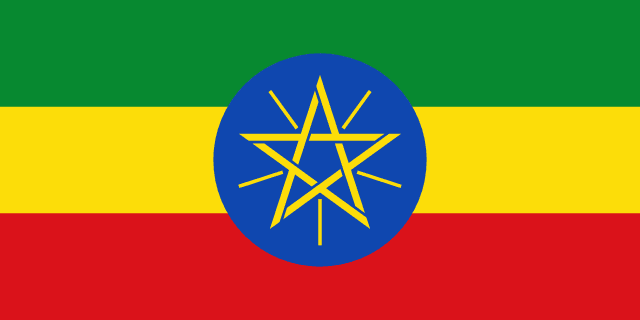
flag — Ethiopia
Nation by Nation
Ethiopia
Government
Government
conventional long form: Federal Democratic Republic of Ethiopia
conventional short form: Ethiopia
local long form: Ityop'iya Federalawi Demokrasiyawi Ripeblik
local short form: Ityop'iya
former: Abyssinia, Italian East Africa
abbreviation: FDRE
etymology: the country name derives from the Greek word "Aethiopia," which in classical times referred to lands south of Egypt in the Upper Nile region
Government type federal parliamentary republic
Capital name: Addis Ababa
geographic coordinates: 9 02 N, 38 42 E
time difference: UTC+3 (8 hours ahead of Washington, DC, during Standard Time)
etymology: the name in Amharic means "new flower" and was bestowed on the city in 1889, three years after its founding
Administrative divisions 10 ethnically based regional states (kililoch, singular - kilil) and 2 self-governing administrations* (astedaderoch, singular - astedader); Adis Abeba* (Addis Ababa), Afar, Amara (Amhara), Binshangul Gumuz, Dire Dawa*, Gambela Hizboch (Gambela Peoples), Hareri Hizb (Harari People), Oromiya (Oromia), Sidama, Sumale (Somali), Tigray, Ye Debub Biheroch Bihereseboch na Hizboch (Southern Nations, Nationalities and Peoples)
Independence oldest independent country in Africa and one of the oldest in the world - at least 2,000 years (may be traced to the Aksumite Kingdom, which coalesced in the first century B.C.)
National holiday Derg Downfall Day (defeat of MENGISTU regime), 28 May (1991)
Constitution history: several previous; latest drafted June 1994, adopted 8 December 1994, entered into force 21 August 1995
amendments: proposals submitted for discussion require two-thirds majority approval in either house of Parliament or majority approval of one-third of the State Councils; passage of amendments other than constitutional articles on fundamental rights and freedoms and the initiation and amendment of the constitution requires two-thirds majority vote in a joint session of Parliament and majority vote by two thirds of the State Councils; passage of amendments affecting rights and freedoms and amendment procedures requires two-thirds majority vote in each house of Parliament and majority vote by all the State Councils
Legal system civil law system
International law organization participation has not submitted an ICJ jurisdiction declaration; non-party state to the ICCt
Citizenship citizenship by birth: no
citizenship by descent only: at least one parent must be a citizen of Ethiopia
dual citizenship recognized: no
residency requirement for naturalization: 4 years
Suffrage 18 years of age; universal
Executive branch chief of state: President SAHLE-WORK Zewde (since 25 October 2018) (2018)
head of government: Prime Minister ABIY Ahmed Ali (since April 2018, began a new five year term on 4 October 2021); Deputy Prime Minister DEMEKE Mekonnen Hassen (since 29 November 2012) (2021)
cabinet: Council of Ministers selected by the prime minister and approved by the House of People's Representatives
elections/appointments: president indirectly elected by both chambers of Parliament for a 6-year term (eligible for a second term); election held on 21 June 2021 and 30 September 2021 (the scheduled 29 August 2020 election was postponed by Prime Minister ABIY due to the COVID-19 pandemic); prime minister designated by the majority party following legislative elections
election results: SAHLE-WORK Zewde elected president during joint session of Parliament, vote - 659 (unanimous); ABIY Ahmed confirmed Prime Minister by House of Peoples' Representatives (4 October 2021)
note: SAHLE-WORK Zewde is the first female elected head of state in Ethiopia; she is currently the only female president in Africa. Former President Dr. Mulatu TESHOME resigned on 25 October 2018, one year ahead of finishing his six-year term.
Legislative branch description: bicameral Parliament consists of: House of Federation or Yefedereshein Mikir Bete (153 seats; members indirectly elected by state assemblies to serve 5-year terms) House of People's Representatives or Yehizb Tewokayoch Mekir Bete (547 seats; members directly elected in single-seat constituencies by simple majority vote; 22 seats reserved for minorities; all members serve 5-year terms)
elections: House of Federation - last held 24 May 2015 (next originally scheduled on 29 August 2020 but postponed a year due to the COVID-19 pandemic) House of People's Representatives - last held on 24 May 2015 (next election to be held June 2021)
election results: House of Federation - percent of vote by coalition/party - NA; seats by coalition/party - NA; composition - men 104, women 49, percent of women 32% House of Representatives - percent of vote by coalition/party - NA; seats by coalition/party - EPRDF 501, SPDP 24, BGPDUP 9, ANDP 8, GPUDM 3, APDO 1, HNL 1; composition - men 335, women 212, percent of women 38.8%; note - total Parliament percent of women 37.3%
note: House of Federation is responsible for interpreting the constitution and federal-regional issues and the House of People's Representatives is responsible for passing legislation
Judicial branch highest courts: Federal Supreme Court (consists of 11 judges); note - the House of Federation has jurisdiction for all constitutional issues
judge selection and term of office: president and vice president of Federal Supreme Court recommended by the prime minister and appointed by the House of People's Representatives; other Supreme Court judges nominated by the Federal Judicial Administrative Council (a 10-member body chaired by the president of the Federal Supreme Court) and appointed by the House of People's Representatives; judges serve until retirement at age 60
subordinate courts: federal high courts and federal courts of first instance; state court systems (mirror structure of federal system); sharia courts and customary and traditional courts
Political parties and leaders national parties: All Ethiopian Unity Organization Alliance for Multination Democratic Federalism National Movement of Amhara Ethiopian Citizens for Social Justice and Democracy or EZEMA [BERHANU Nega] Ethiopian Democratic Union Ethiopian Federal Democratic Unity Forum or MEDREK Ethiopian Freedom Party Ethiopian National Unity Party Ethiopian People’s Revolutionary Party Ethiopian Social Democratic Party Federalist Democratic Forum Freedom and Equality Party Hedase Party Hiber Ethiopia Democratic Party Mother Party New Generation Party Oromo Federalist Congress Prosperity Party or PP
regional parties: Afar Liberation Front Party or ANDF Afar People’s Justice Democratic Party Afar People’s Party or APP Afar Revolutionary Democratic Unity Front Agew National Congress Amhara Democratic Force Movement Arena Tigray for Democracy and Sovereignty Argoba People’s Democratic Organization or APDO Argoba Nationality Democratic Movement Balderas for True Democracy Benishangul People’s Freedom Movement for Peace and Democracy Organization Benishangul People's Liberation Movement Boro Democratic Party Donga People’s Democratic Organization Gambella People’s Freedom Democratic Movement Gambella People’s Freedom Movement Gambella People Justice, Peace and Development Democratic Movement Gambella People’s Liberation Movement Gamo Democratic Party or GDP Gedio People Democratic Organization Harari Democratic Organization Kafa Green Party Kafa Peoples Democratic Union Kimant Democratic Party Kucha People's Democratic Party Mocha Democratic Party National Movement of Amhara National Movement of Wolaita Ogaden National Liberation Front or ONLF Oromo Freedom Movement Oromo Liberation Front Qucha People Democratic Party Raya Rayuma Democratic Party Renaissance Party Sidama Freedom Movement or Sidama Liberation Movement Sidama Hadicho People’s Democratic Organization Sidama People’s Unity Democratic Organization Sidama Unity Party Tigray Democratic Party Union of Tigrians for Democracy and Sovereignty West Somali Democratic Party Wolayta National Movement Wolayta People’s Democratic Front Wolene People's Democratic Party (2020)
notes - Ethiopia has over fifty national-level and regional-level political parties. The ruling party, the Prosperity Party, was created by Prime Minister ABIY in November 2019 from member parties of the former Ethiopian People’s Revolutionary Democratic Front (EPRDF), which included the Amhara Democratic Party (ADP), Oromo Democratic Party (ODP), Southern Ethiopian People's Democratic Movement (SEPDM), plus other EPRDF-allied parties such as the Afar National Democratic Party (ANDP), Benishangul Gumuz People’s Democratic Party (BGPDP), Gambella People’s Democratic Movement (GPDM), Somali People’s Democratic Party (SPDP), and the Harari National League (HNL). Once the Prosperity Party was created, the various ethnically-based parties that comprised or were affiliated with the EPRDF were subsequently disbanded; in January 2021, the Ethiopian electoral board de-registered the Tigray People’s Liberation Front or TPLF; national level parties are qualified to register candidates in multiple regions across Ethiopia; regional parties can register candidates for both national and regional parliaments, but only in one region of Ethiopia
American history and world history can be found at historycental- History's home on the web. Explore our complete time lines of major events in American history as well as World History. Research our special sections on diverse subjects ranging from presidential elections to naval history. Whatever aspect of history you wish learn about, you will find it at Historycentral.com
Favorite Section
Primary Sources 3
World History 6
© 1996-2020 Historycentral .