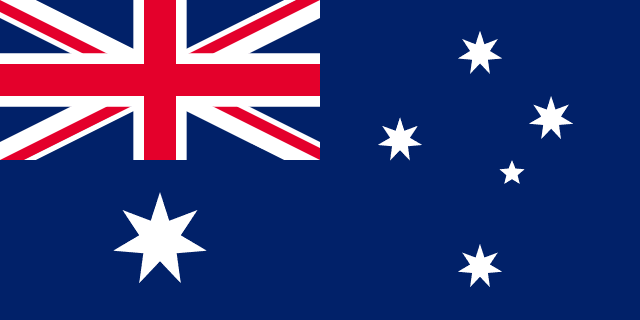
flag — Australia
Nation by Nation
Australia
Transportation
Transportation
number of registered air carriers: 25 inventory of registered aircraft operated by air carriers: 583 annual passenger traffic on registered air carriers: 69,294,187 annual freight traffic on registered air carriers: 1,887,295,820 mt-km (2018) Civil aircraft registration country code prefix: VH (2016) Airports: 480 (2013) country comparison to the world: 16 Airports - with paved runways: total: 349 over 3,047 m: 11 2,438 to 3,047 m: 14 1,524 to 2,437 m: 155 914 to 1,523 m: 155 under 914 m: 14 (2017) Airports - with unpaved runways: total: 131 1,524 to 2,437 m: 16 914 to 1,523 m: 101 under 914 m: 14 (2013) Heliports: 1 (2013) Pipelines: condensate/gas 637 km; gas 30,054 km; liquid petroleum gas 240 km; oil 3,609 km; oil/gas/water 110 km; refined products 72 km (2013) Railways: total: 33,343 km broad gauge: 3,247 km 1.600-m gauge (372 km electrified) standard gauge: 17,446 km 1.435-m gauge (650 km electrified) narrow gauge: 12,318 km 1.067-m gauge (2,075.5 km electrified) other gauge: 35 km (2015) country comparison to the world: 7 Roadways: total: 873,573 km urban: 145,928 km non-urban: 727,645 km (2015) country comparison to the world: 9 Waterways: 2,000 km (mainly used for recreation on Murray and Murray-Darling River systems) (2011) country comparison to the world: 42 Merchant marine: total: 549 by type: bulk carrier 4, general cargo 83, oil tanker 10, other 452 (2017) country comparison to the world: 39 Ports and terminals: major seaport(s): Brisbane, Cairns, Darwin, Fremantle, Geelong, Gladstone, Hobart, Melbourne, Newcastle, Port Adelaide, Port Kembla, Sydney dry bulk cargo port(s): Dampier (iron ore), Dalrymple Bay (coal), Hay Point (coal), Port Hedland (iron ore), Port Walcott (iron ore) container port(s) (TEUs): Brisbane (1,152,000), Melbourne (2,638,000), Sydney (2,330,000) (2015) LNG terminal(s) (export): Darwin, Karratha, Burrup, Curtis Island