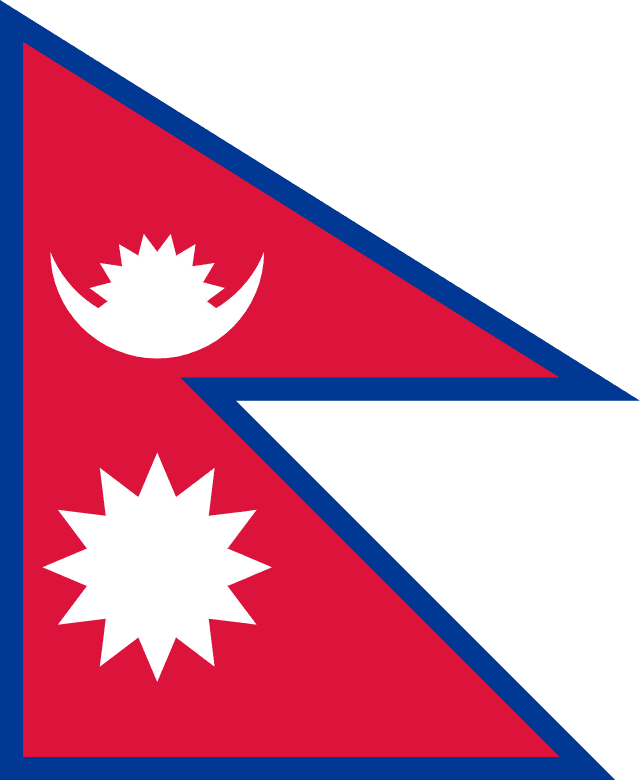
flag — Nepal
Nation by Nation
Nepal
Government
Government
conventional long form: none
conventional short form: Nepal
local long form: none
local short form: Nepal
etymology: the Newar people of the Kathmandu Valley and surrounding areas apparently gave their name to the country; the terms "Nepal," "Newar," "Nepar," and "Newal" are phonetically different forms of the same word Government type
federal parliamentary republic Capital
name: Kathmandu
geographic coordinates: 27 43 N, 85 19 E
time difference: UTC+5.75 (10.75 hours ahead of Washington, DC, during Standard Time)
etymology: name derives from the Kasthamandap temple that stood in Durbar Square; in Sanskrit, kastha means "wood" and mandapa means "pavilion"; the three-story structure was made entirely of wood, without iron nails or supports, and dated to the late 16th century; it collapsed during a 2015 earthquake Administrative divisions
7 provinces (pradesh, singular - pradesh); Bagmati, Gandaki, Karnali, Lumbini, Madhesh, Province No. One, Sudurpashchim Independence
1768 (unified by Prithvi Narayan SHAH) National holiday
Constitution Day, 20 September (2015); note - marks the promulgation of Nepal’s constitution in 2015 and replaces the previous 28 May Republic Day as the official national day in Nepal; the Gregorian day fluctuates based on Nepal’s Hindu calendar Constitution
history: several previous; latest approved by the Second Constituent Assembly 16 September 2015, signed by the president and effective 20 September 2015
amendments: proposed as a bill by either house of the Federal Parliament; bills affecting a state border or powers delegated to a state must be submitted to the affected state assembly; passage of such bills requires a majority vote of that state assembly membership; bills not requiring state assembly consent require at least two-thirds majority vote by the membership of both houses of the Federal Parliament; parts of the constitution on the sovereignty, territorial integrity, independence, and sovereignty vested in the people cannot be amended; amended 2016, 2020 Legal system
English common law and Hindu legal concepts; note - new criminal and civil codes came into effect on 17 August 2018 International law organization participation
has not submitted an ICJ jurisdiction declaration; non-party state to the ICCt Citizenship
citizenship by birth: yes
citizenship by descent only: yes
dual citizenship recognized: no
residency requirement for naturalization: 15 years Suffrage
18 years of age; universal Executive branch
chief of state: President Bidhya Devi BHANDARI (since 29 October 2015); Vice President Nanda Bahadar PUN (since 31 October 2015)
head of government: Prime Minister Sher Bahadur DEUBA (since 13 July 2021); deputy prime ministers Ishwar POKHREL, Upendra YADAV (since 1 June 2018) (an)
cabinet: Council of Ministers appointed by the prime minister; cabinet dominated by the Nepal Communist Party
elections/appointments: president indirectly elected by an electoral college of the Federal Parliament and of the state assemblies for a 5-year term (eligible for a second term); election last held 13 March 2018 (next to be held in 2023); prime minister indirectly elected by the Federal Parliament
election results: Bidhya Devi BHANDARI reelected president; electoral vote - Bidhya Devi BHANDARI (CPN-UML) 39,275, Kumari Laxmi RAI (NC) 11,730 Legislative branch
description: bicameral Federal Parliament consists of: National Assembly (59 seats; 56 members, including at least 3 women, 1 Dalit, 1 member with disabilities, or 1 minority indirectly elected by an electoral college of state and municipal government leaders, and 3 members, including 1 woman, nominated by the president of Nepal on the recommendation of the government; members serve 5-year terms with renewal of one-third of the membership every 2 years) House of Representatives (275 seats statutory, current 271 with 4 vacant; 165 members directly elected in single-seat constituencies by simple majority vote and 110 members directly elected in a single nationwide constituency by closed-list proportional representation vote, with a threshold of 3% overall valid vote to be allocated a seat; members serve 5-year terms); note - the House of Representatives was dissolved on 22 May 2021, but on 13 July, the Supreme Court directed its reinstatement
elections: National Assembly - last held on 26 January 2022 (next to be held in 2024) first election for House of Representatives held on 26 November and 7 December 2017 (next to be held on 20 November 2022)
election results: National Assembly - percent of vote by party - NA; seats by party - NCP 42, NC 13, FSFN 2, RJPN 2; composition - men 37, women 22, percent of women 37.3% House of Representatives - percent of vote by party - NA; seats by party - NCP 174, NC 63, RJPN 17, FSFN 16, vacant 4, independent 1; composition - men 180, women 91, percent of women 33.6%; note - total Federal Parliament percent of women 33.8% Judicial branch
highest court(s): Supreme Court (consists of the chief justice and up to 20 judges)
judge selection and term of office: Supreme Court chief justice appointed by the president upon the recommendation of the Constitutional Council, a 5-member, high-level advisory body headed by the prime minister; other judges appointed by the president upon the recommendation of the Judicial Council, a 5-member advisory body headed by the chief justice; the chief justice serves a 6-year term; judges serve until age 65
subordinate courts: High Court; district courts Political parties and leaders
the Election Commission of Nepal granted ballot access under the proportional system to 88 political parties for the November-December 2017 House of Representatives election to the Federal Parliament; of these, the following 8 parties won seats: Federal Socialist Forum, Nepal or FSFN [Upendra YADAV] Naya Shakti Party, Nepal [Baburam BHATTARAI] Nepal Communist Party or NCP [Khadga Prasad OLI, Pushpa Kamal DAHAL] Nepali Congress or NC [Sher Bahadur DEUBA] Nepal Mazdoor Kisan Party (Nepal Workers' and Peasants' Party) or NWPP [Narayan Man BIJUKCHHE] Rastriya Janamorcha (National People's Front) [Chitra Bahadur K.C.] Rastriya Janata Party (National People's Party, Nepal) or RJPN [Mahanta THAKUR] Rastriya Prajatantra Party (National Democratic Party) or RPP [Rajendra Prasad LINGDEN]
American history and world history can be found at historycental- History's home on the web. Explore our complete time lines of major events in American history as well as World History. Research our special sections on diverse subjects ranging from presidential elections to naval history. Whatever aspect of history you wish learn about, you will find it at Historycentral.com
Favorite Section

Primary Sources 3
World History 6
© 1996-2020 Historycentral .