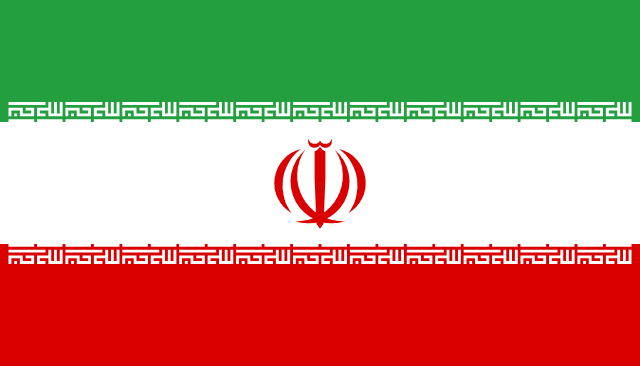
flag — Iran
Nation by Nation
Iran
Government
Government
conventional long form: Islamic Republic of Iran
conventional short form: Iran
local long form: Jomhuri-ye Eslami-ye Iran
local short form: Iran
former: Persia
etymology: name derives from the Avestan term "aryanam" meaning "Land of the Noble [Ones]"
Government type theocratic republic
Capital name: Tehran
geographic coordinates: 35 42 N, 51 25 E
time difference: UTC+3.5 (8.5 hours ahead of Washington, DC, during Standard Time)
daylight saving time: +1hr, begins fourth Wednesday in March; ends fourth Friday in September
etymology: various explanations of the city's name have been proffered, but the most plausible states that it derives from the Persian words "tah" meaning "end or bottom" and "ran" meaning "[mountain] slope" to signify "bottom of the mountain slope"; Tehran lies at the bottom slope of the Elburz Mountains
Administrative divisions 31 provinces (ostanha, singular - ostan); Alborz, Ardabil, Azarbayjan-e Gharbi (West Azerbaijan), Azarbayjan-e Sharqi (East Azerbaijan), Bushehr, Chahar Mahal va Bakhtiari, Esfahan, Fars, Gilan, Golestan, Hamadan, Hormozgan, Ilam, Kerman, Kermanshah, Khorasan-e Jonubi (South Khorasan), Khorasan-e Razavi (Razavi Khorasan), Khorasan-e Shomali (North Khorasan), Khuzestan, Kohgiluyeh va Bowyer Ahmad, Kordestan, Lorestan, Markazi, Mazandaran, Qazvin, Qom, Semnan, Sistan va Baluchestan, Tehran, Yazd, Zanjan
Independence 1 April 1979 (Islamic Republic of Iran proclaimed); notable earlier dates: ca. 550 B.C. (Achaemenid (Persian) Empire established); A.D. 1501 (Iran reunified under the Safavid Dynasty); 1794 (beginning of Qajar Dynasty); 12 December 1925 (modern Iran established under the PAHLAVI Dynasty)
National holiday Republic Day, 1 April (1979)
Constitution history: previous 1906; latest adopted 24 October 1979, effective 3 December 1979
amendments: proposed by the supreme leader – after consultation with the Exigency Council – and submitted as an edict to the "Council for Revision of the Constitution," a body consisting of various executive, legislative, judicial, and academic leaders and members; passage requires absolute majority vote in a referendum and approval of the supreme leader; articles including Iran’s political system, its religious basis, and its form of government cannot be amended; amended 1989
Legal system religious legal system based on secular and Islamic law
International law organization participation has not submitted an ICJ jurisdiction declaration; non-party state to the ICCt
Citizenship citizenship by birth: no
citizenship by descent only: the father must be a citizen of Iran
dual citizenship recognized: no
residency requirement for naturalization: 5 years
Suffrage 18 years of age; universal
Executive branch chief of state: Supreme Leader Ali Hoseini-KHAMENEI (since 4 June 1989)
head of government: President Ebrahim RAISI (since 18 June 2021); First Vice President Mohammad MOKHBER (since 8 August 2021)
cabinet: Council of Ministers selected by the president with legislative approval; the supreme leader has some control over appointments to several ministries
elections/appointments: supreme leader appointed for life by Assembly of Experts; president directly elected by absolute majority popular vote in 2 rounds if needed for a 4-year term (eligible for a second term and an additional nonconsecutive term); election last held on 18 June 2021 (next to be held in June 2025)
election results: 2021: Ebrahim RAISI elected president; percent of vote - Ebrahim RAISI (CCA) 72.4%, Mohsen REZAI (RFII) 13.8%, Abbdolnaser HEMATI (ECP) 9.8%, Amir-Hosein Qazizadeh-HASHEMI (Islamic Law Party) 4%
2017: Hasan Fereidun RUHANI reelected president; percent of vote - Hasan Fereidun RUHANI (Moderation and Development Party) 58.8%, Ebrahim RAISI (Combat Clergy Association) 39.4% , Mostafa Mir-SALIM Islamic Coalition Party) 1.2%, Mostafa HASHEMI-TABA(Executives of Construction Party) 0.5%
note: 3 oversight bodies are also considered part of the executive branch of government
Legislative branch description: unicameral Islamic Consultative Assembly or Majles-e Shura-ye Eslami or Majles (290 seats; 285 members directly elected in single- and multi-seat constituencies by 2-round vote, and 1 seat each for Zoroastrians, Jews, Assyrian and Chaldean Christians, Armenians in the north of the country and Armenians in the south; members serve 4-year terms); note - all candidates to the Majles must be approved by the Council of Guardians, a 12-member group of which 6 are appointed by the supreme leader and 6 are jurists nominated by the judiciary and elected by the Majles
elections: first round held on 21 February 2020 and second round for 11 remaining seats held on 11 September 2020 (next full Majles election to be held in 2024)
election results: percent of vote by coalition (first round) - NA; seats by coalition (first round) - conservatives and hardliners 226, reformists 19, independents 40, religious minorities 5; as of June 2021 by-elections; composition - men 274, women 16, percent of women 5.6%
Judicial branch highest courts: Supreme Court (consists of the chief justice and organized into 42 two-bench branches, each with a justice and a judge)
judge selection and term of office: Supreme Court president appointed by the head of the High Judicial Council (HJC), a 5-member body to include the Supreme Court chief justice, the prosecutor general, and 3 clergy, in consultation with judges of the Supreme Court; president appointed for a single, renewable 5-year term; other judges appointed by the HJC; judge tenure NA
subordinate courts: Penal Courts I and II; Islamic Revolutionary Courts; Courts of Peace; Special Clerical Court (functions outside the judicial system and handles cases involving clerics); military courts
Political parties and leaders Combatant Clergy Association (an active political group) Executives of Construction Party Followers of the Guardianship of the Jurisprudent [Ali LARIJANI] Front of Islamic Revolutionary Stability [Morteza AGHA-TEHRANI, general secretary] Islamic Coalition Party Islamic Iran Participation Front [associated with former President Mohammed KHATAMI] Islamic Law Party Militant Clerics Society Moderation and Development Party National Trust Party National Unity Party Pervasive Coalition of Reformists [Ali SUFI, chairman] (includes Council for Coordinating the Reforms Front, National Trust Party, Union of Islamic Iran People Party, Moderation and Development Party) Principlists Grand Coalition (includes Combatant Clergy Association and Islamic Coalition Party, Society of Devotees and Pathseekers of the Islamic Revolution, Front of Islamic Revolution Stability) Progress, Welfare, and Justice Front Progress and Justice Population of Islamic Iran or PJP [Hosein GHORBANZADEH, general secretary] Resistance Front of Islamic Iran [Yadollah HABIBI, general secretary] Steadfastness Front Union of Islamic Iran People's Party Wayfarers of the Islamic Revolution