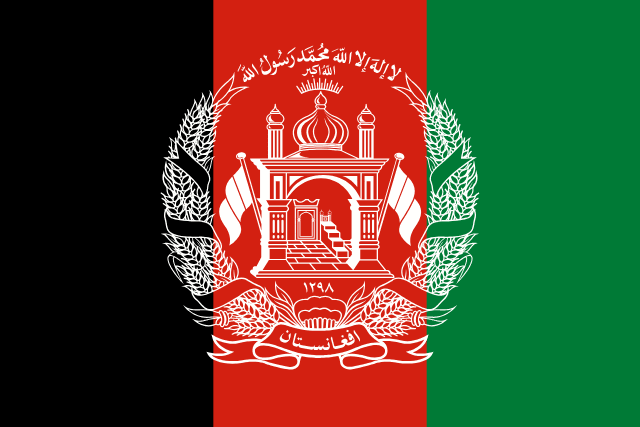
flag — Afghanistan
Nation by Nation
Afghanistan
Government
Government
Independence Da y, 19 August (1919) Constitution: history: several previous; latest drafted 14 December 2003 - 4 January 2004, signed 16 January 2004, ratified 26 January 2004 amendments: proposed by a commission formed by presidential decree followed by the convention of a Grand Council (Loya Jirga) decreed by the president; passage requires at least two-thirds majority vote of the Loya Jirga membership and endorsement by the president (2017) Legal system: mixed legal system of civil, customary, and Islamic law International law organization participation: has not submitted an ICJ jurisdiction declaration; accepts ICCt jurisdiction Citizenship: citizenship by birth: no citizenship by descent only: at least one parent must have been born in - and continuously lived in - Afghanistan dual citizenship recognized: no residency requirement for naturalization: 5 years Suffrage: 18 years of age; universal Executive branch: chief of state : President of the Islamic Republic of Afghanistan Ashraf GHANI Ahmadzai (since 29 September 2014); CEO Abdullah ABDULLAH, Dr. (since 29 September 2014); First Vice President Abdul Rashid DOSTAM (since 29 September 2014); Second Vice President Sarwar DANESH (since 29 September 2014); First Deputy CEO Khyal Mohammad KHAN; Second Deputy CEO Mohammad MOHAQQEQ; note - the president is both chief of state and head of government head of government: President of the Islamic Republic of Afghanistan Ashraf GHANI Ahmadzai (since 29 September 2014); CEO Abdullah ABDULLAH, Dr. (since 29 September 2014); First Vice President Abdul Rashid DOSTAM (since 29 September 2014); Second Vice President Sarwar DANESH (since 29 September 2014); First Deputy CEO Khyal Mohammad KHAN; Second Deputy CEO Mohammad MOHAQQEQ cabinet: Cabinet consists of 25 ministers appointed by the president, approved by the National Assembly elections/appointments: president directly elected by absolute majority popular vote in 2 rounds if needed for a 5-year term (eligible for a second term); election last held in 2 rounds on 5 April and 14 June 2014 (next to be held in 2018) election results: Ashraf GHANI elected president in the second round; percent of vote in first round - Abdullah ABDULLAH (National Coalition of Afghanistan) 45%, Ashraf GHANI (independent) 31.6%, Zalmai RASSOUL 11.4%, other 12%; percent of vote in second round - Ashraf GHANI 56.4%, Abdullah ABDULLAH 43.6% Legislative branch: description: bicameral National Assembly consists of the Meshrano Jirga or House of Elders (102 seats; 34 members indirectly elected by district councils to serve 3-year terms, 34 indirectly elected by provincial councils to serve 4-year terms, and 34 nominated by the president of which 17 must be women, 2 must represent the disabled, and 2 must be Kuchi nomads; members serve 5-year terms) and the Wolesi Jirga or House of People (249 seats; members directly elected in multi-seat constituencies by proportional representation vote to serve 5-year terms) note: the constitution allows the government to convene a constitutional Loya Jirga (Grand Council) on issues of independence, national sovereignty, and territorial integrity; it can amend the provisions of the constitution and prosecute the president; it consists of members of the National Assembly and chairpersons of the provincial and district councils; no constitutional Loya Jirga has ever been held, and district councils have never been elected; the president appointed 34 members of the Meshrano Jirga that the district councils should have indirectly elected elections: Meshrano Jirga - last held 10 January 2015 (next to be held in 2018); Wolesi Jirga - last held on 18 September 2010 (next originally scheduled on 15 October 2016 but postponed to 7 July 2018) election results: Meshrano Jirga - percent of vote by party - NA; seats by party - NA; Meshrano Jirga - percent of vote by party NA; seats by party - NA Judicial branch: highest court(s): Supreme Court or Stera Mahkama (consists of the supreme court chief and 8 justices organized into criminal, public security, civil, and commercial divisions or dewans) judge selection and term of office: court chief and justices appointed by the president with the approval of the Wolesi Jirga; court chief and justices serve single 10-year terms subordinate courts: Appeals Courts; Primary Courts; Special Courts for issues including narcotics, security, property, family, and juveniles Political parties and leaders: note - the Ministry of Justice licensed 57 political parties as of September 2016a