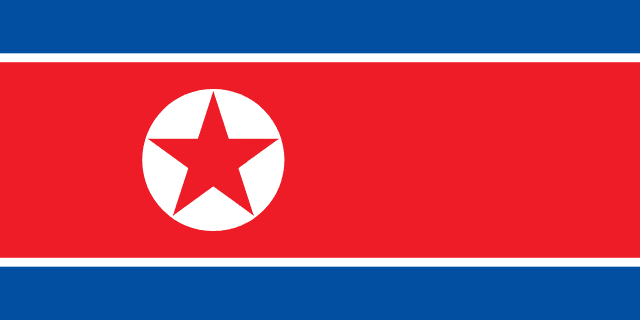
flag — North Korea
Nation by Nation
North Korea
History
History
The first recorded kingdom on the Korean Peninsula, Choson, dates back to around 2300 B.C. Over the centuries, three main kingdoms - Kogoryo, Paekche, and Silla - were established on the Peninsula. By the 5th century A.D., Kogoryo had emerged as the most powerful, with control over much of the Peninsula and part of Manchuria. However, Silla allied with the Chinese to create the first unified Korean state in the late 7th century. Following the collapse of Silla in the 9th century, Korea was unified under the Koryo and Chosen dynasties.
Korea became the object of intense imperialistic rivalry between the Chinese, Japanese, and Russian empires in the late 19th and early 20th centuries. After the Sino-Japanese War and the Russo-Japanese War, Korea was occupied by Imperial Japan. In 1910, Japan formally annexed the entire peninsula. After World War II, Korea was split, with the northern half coming under Soviet-sponsored communist control. After the Korean War, North Korea adopted a policy of "self-reliance" as a check against outside influence, and demonized the US as the ultimate threat to its social system. KIM Jong Un, the current leader of North Korea, has occupied the regime's highest political and military posts since 2011.
North Korea has a history of provocative regional military actions and posturing that have limited its international engagement, particularly economically. These actions include the proliferation of military-related items, long-range missile development, WMD programs including nuclear tests, and large conventional armed forces. In 2013, North Korea declared a policy of simultaneous development of its nuclear weapons program and economy. In late 2017, KIM Jong Un declared the North's nuclear weapons development complete and announced a pivot towards diplomacy, including a re-prioritization of economic development, a pause in missile testing, and a refrain from anti-US rhetoric. Since 2018, KIM has participated in multiple meetings with world leaders, including the Chinese President, the South Korean President, and the US President. Despite this, North Korea has continued developing its ballistic missile program and is still a major concern to the international community.