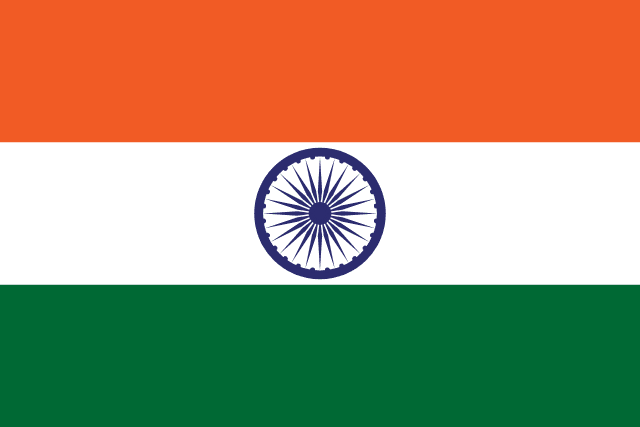
flag — India
Nation by Nation
India
Government
Government
conventional long form: Republic of India
conventional short form: India
local long form: Republic of India/Bharatiya Ganarajya
local short form: India/Bharat
etymology: the English name derives from the Indus River; the Indian name "Bharat" may derive from the "Bharatas" tribe mentioned in the Vedas of the second millennium B.C.; the name is also associated with Emperor Bharata, the legendary conqueror of all of India
Government type federal parliamentary republic
Capital name: New Delhi
geographic coordinates: 28 36 N, 77 12 E
time difference: UTC+5.5 (10.5 hours ahead of Washington, DC, during Standard Time)
etymology: the city's name is associated with various myths and legends; the original name for the city may have been Dhilli or Dhillika; alternatively, the name could be a corruption of the Hindustani words "dehleez" or "dehali" - both terms meaning "threshold" or "gateway" - and indicative of the city as a gateway to the Gangetic Plain; after the British decided to move the capital of their Indian Empire from Calcutta to Delhi in 1911, they created a new governmental district south of the latter designated as New Delhi; the new capital was not formally inaugurated until 1931
Administrative divisions 28 states and 8 union territories*; Andaman and Nicobar Islands*, Andhra Pradesh, Arunachal Pradesh, Assam, Bihar, Chandigarh*, Chhattisgarh, Dadra and Nagar Haveli and Daman and Diu*, Delhi*, Goa, Gujarat, Haryana, Himachal Pradesh, Jammu and Kashmir*, Jharkhand, Karnataka, Kerala, Ladakh*, Lakshadweep*, Madhya Pradesh, Maharashtra, Manipur, Meghalaya, Mizoram, Nagaland, Odisha, Puducherry*, Punjab, Rajasthan, Sikkim, Tamil Nadu, Telangana, Tripura, Uttar Pradesh, Uttarakhand, West Bengal
note: although its status is that of a union territory, the official name of Delhi is National Capital Territory of Delhi
Independence 15 August 1947 (from the UK)
National holiday Republic Day, 26 January (1950)
Constitution history: previous 1935 (preindependence); latest draft completed 4 November 1949, adopted 26 November 1949, effective 26 January 1950
amendments: proposed by either the Council of States or the House of the People; passage requires majority participation of the total membership in each house and at least two-thirds majority of voting members of each house, followed by assent of the president of India; proposed amendments to the constitutional amendment procedures also must be ratified by at least one half of the India state legislatures before presidential assent; amended many times, last in 2020
Legal system common law system based on the English model; separate personal law codes apply to Muslims, Christians, and Hindus; judicial review of legislative acts
International law organization participation accepts compulsory ICJ jurisdiction with reservations; non-party state to the ICCt
Citizenship citizenship by birth: no
citizenship by descent only: at least one parent must be a citizen of India
dual citizenship recognized: no
residency requirement for naturalization: 5 years
Suffrage 18 years of age; universal
Executive branch chief of state: President Ram Nath KOVIND (since 25 July 2017); Vice President M. Venkaiah NAIDU (since 11 August 2017)
head of government: Prime Minister Narendra MODI (since 26 May 2014)
cabinet: Union Council of Ministers recommended by the prime minister, appointed by the president
elections/appointments: president indirectly elected by an electoral college consisting of elected members of both houses of Parliament for a 5-year term (no term limits); election last held on 17 July 2017 (next to be held in July 2022); vice president indirectly elected by an electoral college consisting of elected members of both houses of Parliament for a 5-year term (no term limits); election last held on 5 August 2017 (next to be held in August 2022); following legislative elections, the prime minister is elected by Lok Sabha members of the majority party
election results: Ram Nath KOVIND elected president; percent of electoral college vote - Ram Nath KOVIND (BJP) 65.7% Meira KUMAR (INC) 34.3%; M. Venkaiah NAIDU elected vice president; electoral college vote - M. Venkaiah NAIDU (BJP) 516, Gopalkrishna GANDHI (independent) 244
Legislative branch description: bicameral Parliament or Sansad consists of: Council of States or Rajya Sabha (245 seats; 233 members indirectly elected by state and territorial assemblies by proportional representation vote and 12 members appointed by the president; members serve 6-year terms with one-third of the membership renewed every 2 years at various dates) House of the People or Lok Sabha (545 seats; 543 members directly elected in single-seat constituencies by simple majority vote and 2 appointed by the president; members serve 5-year terms)
elections: Council of States - last held by state and territorial assemblies at various dates in 2019 (in progress March through July 2022 to fill 70 expiry seats)
House of the People - last held April-May 2019 in 7 phases (next to be held in 2024)
election results: Council of States - percent of vote by party - NA; seats by party - BJP 97, INC 34, AITC 13, DMK 10, other 2, independent 2; composition - men 209, women 29, percent of women 13.8%
House of the People - percent of vote by party - BJP 55.8%, INC 9.6%, AITC 4.4%, YSRC 4.4%, DMK 4.2%, SS 3.3%, JDU 2.9%, BJD 2.2%, BSP 1.8%, TRS 1.7%, LJP 1.1%, NCP 0.9%, SP 0.9%, other 6.4%, independent 0.7%; seats by party - BJP 303, INC 52, DMK 24, AITC 22, YSRC 22, SS 18, JDU 16, BJD 12, BSP 10, TRS 9, LJP 6, NCP 5, SP 5, other 35, independent 4, vacant 2; composition - men 465, women 78, percent of women 14.3%; note - total Parliament percent of women 11.3%
Judicial branch highest courts: Supreme Court (consists of 28 judges, including the chief justice)
judge selection and term of office: justices appointed by the president to serve until age 65
subordinate courts: High Courts; District Courts; Labour Court
note: in mid-2011, India’s Cabinet approved the "National Mission for Justice Delivery and Legal Reform" to eliminate judicial corruption and reduce the backlog of cases
Political parties and leaders Aam Aadmi Party or AAP [Arvind KEJRIWAL] All India Trinamool Congress or AITC [Mamata BANERJEE] Bahujan Samaj Party or BSP [MAYAWATI] Bharatiya Janata Party or BJP [Jagat Prakash NADDA] Biju Janata Dal or BJD [Naveen PATNAIK] Communist Party of India-Marxist or CPI(M) [Sitaram YECHURY] Dravida Munnetra Khazhagam [Muthuvel Karunanidhi STALIN] Indian National Congress or INC [Sonia GANDHI] Nationalist Congress Party or NCP [Sharad PAWAR] Rashtriya Janata Dal or RJD [Lalu Prasad YADAV] Samajwadi Party or SP [Akhilesh YADAV] Shiromani Akali Dal or SAD [Sukhbir Singh BADAL] Shiv Sena or SS [Uddhav THACKERAY] Telegana Rashtra Samithi or TRS [K. Chandrashekar RAO] Telugu Desam Party or TDP [Chandrababu NAIDU] YSR Congress or YSRC [Jagan Mohan REDDY]
note: India has dozens of national and regional political parties