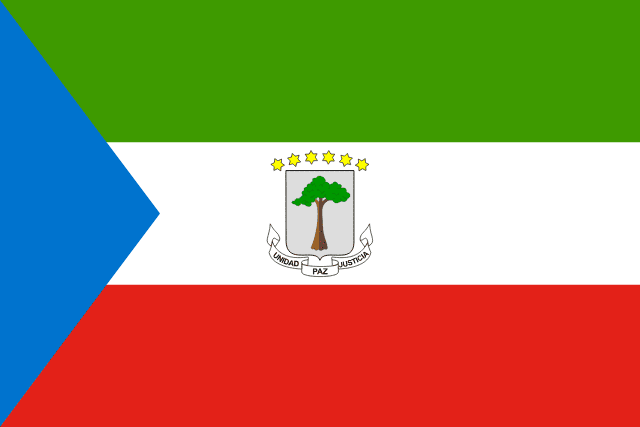
flag — Equatorial Guinea
Nation by Nation
Equatorial Guinea
Government
Government
Government type presidential republic
Capital name: Malabo; note - a new capital of Cuidad de la Paz (formerly referred to as Oyala) is being built on the mainland near Djibloho; Malabo is on the island of Bioko
geographic coordinates: 3 45 N, 8 47 E
time difference: UTC+1 (6 hours ahead of Washington, DC, during Standard Time)
etymology: named after Malabo Lopelo Melaka (1837–1937), the last king of the Bubi, the ethnic group indigenous to the island of Bioko; the name of the new capital, Cuidad de la Paz, translates to "City of Peace" in Spanish
Administrative divisions 8 provinces (provincias, singular - provincia); Annobon, Bioko Norte, Bioko Sur, Centro Sur, Djibloho, Kie-Ntem, Litoral, Wele-Nzas
Independence 12 October 1968 (from Spain)
National holiday Independence Day, 12 October (1968)
Constitution history: previous 1968, 1973, 1982; approved by referendum 17 November 1991
amendments: proposed by the president of the republic or supported by three fourths of the membership in either house of the National Assembly; passage requires three-fourths majority vote by both houses of the Assembly and approval in a referendum if requested by the president; amended several times, last in 2012
Legal system mixed system of civil and customary law
International law organization participation accepts compulsory ICJ jurisdiction; accepts ICCt jurisdiction
Citizenship citizenship by birth: no
citizenship by descent only: at least one parent must be a citizen of Equatorial Guinea
dual citizenship recognized: no
residency requirement for naturalization: 10 years
Suffrage 18 years of age; universal
Executive branch chief of state: President Brig. Gen. (Ret.) Teodoro OBIANG Nguema Mbasogo (since 3 August 1979 when he seized power in a military coup); Vice President Teodoro Nguema OBIANG Mangue(since 2012)
head of government: Prime Minister Francisco Pascual Eyegue OBAMA Asue (since 23 June 2016); First Deputy Prime Minister Clemente Engonga NGUEMA Onguene (since 23 June 2016); Second Deputy Prime Minister Angel MESIE Mibuy (since 5 February 2018); Third Deputy Prime Minister Alfonso Nsue MOKUY (since 23 June 2016)
cabinet: Council of Ministers appointed by the president and overseen by the prime minister
elections/appointments: president directly elected by simple majority popular vote for a 7-year term (eligible for a second term); election last held on 24 April 2016 (next to be held in 2023); prime minister and deputy prime ministers appointed by the president
election results: Teodoro OBIANG Nguema Mbasogo reelected president; percent of vote - Teodoro OBIANG Nguema Mbasogo (PDGE) 93.5%, other 6.5%
Legislative branch description: bicameral National Assembly or Asemblea Nacional consists of: Senate or Senado (70 seats; 55 members directly elected in multi-seat constituencies by closed party-list proportional representation vote and 15 appointed by the president) Chamber of Deputies or Camara de los Diputados (100 seats; members directly elected in multi-seat constituencies by closed paryt-list proportional representation vote to serve 5-year terms)
elections: Senate - last held on 12 November 2017 (next to be held in 2022/2023) Chamber of Deputies - last held on 12 November 2017 (next to be held in 2022/2023)
election results: Senate - percent of vote by party - NA; seats by party - PDGE and aligned coalition 70; composition - men 60, women 10, percent of women 14.3%
Chamber of Deputies - percent of vote by party - NA; seats by party - PDGE 99, CI 1; composition - men 78, women 22, percent of women 22%; note - total National Assembly percent of women 18.8%
Judicial branch highest courts: Supreme Court of Justice (consists of the chief justice - who is also chief of state - and 9 judges organized into civil, criminal, commercial, labor, administrative, and customary sections); Constitutional Court (consists of the court president and 4 members)
judge selection and term of office: Supreme Court judges appointed by the president for 5-year terms; Constitutional Court members appointed by the president, 2 of whom are nominated by the Chamber of Deputies; note - judges subject to dismissal by the president at any time
subordinate courts: Court of Guarantees; military courts; Courts of Appeal; first instance tribunals; district and county tribunals
Political parties and leaders Convergence Party for Social Democracy or CPDS [Andres ESONO ONDO] Democratic Party for Equatorial Guinea or PDGE [Teodoro Obiang NGUEMA MBASOGO] Electoral Coalition or EC Juntos Podemos (coalition includes CPDS, FDR, UDC) National Congress of Equatorial Guinea [Agustin MASOKO ABEGUE] National Democratic Party [Benedicto OBIANG MANGUE] National Union for Democracy [Thomas MBA MONABANG] Popular Action of Equatorial Guinea or APGE [Carmelo MBA BACALE] Popular Union or UP [Daniel MARTINEZ AYECABA] Center Right Union or UCD [Avelino MOCACHE MEHENGA] not officially registered parties: Citizens for Innovation or CI [Gabriel Nse Obiang OBONO] Democratic Republican Force or FDR [Guillermo NGUEMA ELA] Party for Progress of Equatorial Guinea or PPGE [Severo MOTO]