Navigating the Unknown: The Hidden Math of the Age of Exploration
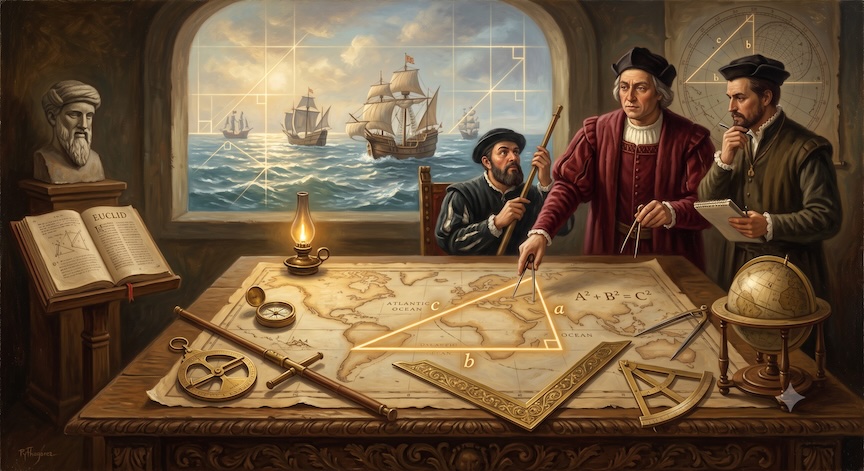
When Jacques Cartier sailed into the Gulf of St. Lawrence in 1534, he wasn't just relying on courage and good luck. Tucked among the ropes and salted meat on his ship was a small collection of instruments — a compass, an astrolabe, or a cross-staff — and behind every one of them was math. Not the abstract kind taught in a classroom, but math that could mean the difference between finding land and disappearing into open water forever.
It's easy to picture the Age of Exploration as a story of bravery alone. But the true engine behind Columbus, Cartier, Magellan, and every navigator who followed them was geometry. Specifically, a lot of it traced back to a 2,500-year-old idea: the relationship between the sides of a right triangle.
Sailing Without a Straight Line
Ships almost never traveled in a perfectly straight line to their destination. Wind, current, and the shape of coastlines forced constant course changes. To keep track of where they actually were, navigators used a method called dead reckoning. Using a compass for direction, a sandglass for time, and a floating log line to estimate speed, a navigator would calculate how far the ship had traveled on a given heading, then plot that distance on a chart.
Here's where the hidden geometry comes in. A ship sailing northeast, for example, isn't just moving north or just moving east — it's moving along the diagonal of an invisible right triangle. The distance actually traveled is the hypotenuse; the ship's progress north and its progress east are the two legs. Navigators increasingly relied on tables and plane-sailing methods to break angled courses into these components. It was right-triangle geometry in action, the same family of ideas behind the Pythagorean theorem, even if sailors aboard a caravel would not have described it that way.
Measuring the Sky to Find the Sea
Dead reckoning alone drifted with error over long voyages, so explorers cross-checked their position using the stars. Instruments like the mariner's astrolabe and the cross-staff, sometimes called a Jacob's staff — let a navigator measure the angle between the horizon and a celestial body like the North Star or the noon sun. That angle told them their latitude.
The cross-staff is a particularly elegant example of triangle math at work. A sailor lined up one end of a sliding crosspiece with the horizon and the other with a star, effectively using the geometry between the observer, the horizon, and the sky. The angle produced by that setup, combined with known star positions, translated into one crucial coordinate on Earth: latitude. Longitude remained much harder to know accurately for centuries. It's a reminder that trigonometry and geometry weren't confined to schoolrooms in the age of sail. They were survival tools, refined and carried in wooden boxes across the Atlantic.
From Cartier's Deck to Modern Engineering
None of this required Cartier or his crew to know the name Pythagoras, but they were using his theorem's core principle just the same: if you know two sides of a right triangle, you can always find the third. That single idea, a² + b² = c², connected ancient Greek mathematics to 16th-century transatlantic exploration, and geometry still underpins modern GPS systems.
It's a useful bit of perspective the next time a phone points you home in seconds: the underlying mathematical habit is not so different from the one that helped Cartier chart the coast of what would become Canada, one imperfect, hard-won triangle at a time.
Why This Still Matters
What makes the Age of Exploration genuinely remarkable isn't just that ships crossed unknown oceans — it's that they did it with tools built on principles that hadn't fundamentally changed since antiquity. The compass told sailors which way they were pointed. The astrolabe and cross-staff told them where they stood beneath the stars. And running quietly underneath both was geometry old enough to have been scratched into wax tablets in ancient Greece.
History tends to remember explorers for the lands they found. It's worth also remembering the math that got them there — imperfect, hand-calculated, and absolutely essential.