281896

portrait — William McKinley
Presidential Election · 1896
The Election of 1896
William McKinley defeats William Jennings Bryan
McKinley defeats the populist orator Bryan in a battle over the gold standard.
Republican VictoryWilliam McKinley defeats William Jennings Bryan
McKinley defeats the populist orator Bryan in a battle over the gold standard.
Republican VictoryThe Result
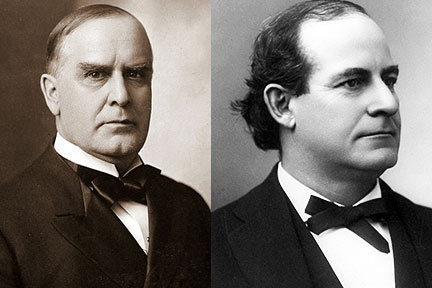

McKinley defeats the populist orator Bryan in a battle over the gold standard.
In 1893, one of the most severe economic crises in US history developed. The nation found itself in a deep depression. President Cleveland blamed the depression on the move to accept silver currency. As a result, business confidence was weakened. Cleveland's solution was a repeal of the Sherman Silver Purchase Act. And thus a return to a currency supported only by gold. Repealing the Silver Purchase Act resulted in a tightening of the supply of money. This only served to worsen the economic situation.
Democrats lost control of both the Senate and the House of Representatives in the 1994 Congressional election. When the party met for their convention in Chicago, the party was ready for a change. William Jennings Bryan gave an electrifying speech and became the party's nominee. The party adopted a platform favoring free silver. The Populist Party decided to support Bryan. The Populist Party chose not to run a nominee of their own.
Republicans nominated the popular Governor of Ohio, William McKinley, on the first ballot. McKinley was backed by Marcus Hanna, a wealthy industrialist, and Chairman of the Republican Party. Contrasts marked the 1896 presidential campaign. William Jennings Bryan crisscrossed the country, making personal appearances. He was accused of lacking dignity. Bryan answered: "I would rather have it said that I lacked dignity, than that I lacked backbone to meet the enemies of the government who works against its welfare from Wall Street." McKinley stayed home and ran a front porch campaign. Thousands of people came to his home and heard him speak. In the campaign, Bryan was depicted as a "radical and a socialist," while McKinley was called a "tool of business." In this election, money played an important role, for the first time, in a political campaign. McKinley raised $3 million (mostly from business interests), compared to $600,000 raised by Bryan. Bryan was able to win almost all of the states of the West. However, Bryan had virtually no success in the growing industrial cities of the East. The result of the election showed how the farmers' vote was no longer decisive. By 1896, only 1/3 of Americans lived on farms. It was also clear that the number of Americans living on farms was dropping rapidly. McKinley won the election.
The Popular Vote
The recorded popular vote in each state.
Figures as recorded by HistoryCentral.