Howard Hughes Slashes the Speed Record
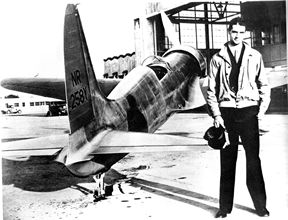
On September 13, 1935, twenty-nine-year-old millionaire Howard Hughes climbed into the cockpit of a machine he had spent eighteen months and a small fortune designing and building for a single purpose: to be the fastest landplane on earth. The Hughes H-1 Racer, designed by Hughes and engineer Richard Palmer and built by mechanic Glenn Odekirk, had made its maiden flight barely a month earlier at Grand Central Airport in Glendale, California.
It was a radical aircraft — a single-seat, low-wing monoplane with a bare aluminum fuselage polished to a mirror finish, flush riveting that eliminated every unnecessary bump of drag, retractable landing gear (still a novelty in 1935), and a close-fitting bell-shaped engine cowling wrapped around a Pratt & Whitney Twin Wasp Junior radial engine that, fed 100-octane fuel, could produce nearly 1,000 horsepower. Hughes was so concerned about minimizing drag that even the slots of the aircraft's screws were turned to be in line with the airstream.
That morning, over a specially instrumented three-kilometer course at Martin Field near Santa Ana, California — the same stretch of flat Irvine ranch land that physicist Albert A. Michelson had once used to measure the speed of light — Hughes broke the world landplane speed record, clocking 352.39 mph averaged over four timed passes, smashing the previous mark of 314 mph held by France's Raymond Delmotte by 38 miles per hour. Amelia Earhart served as Hughes's observer from the air.
The aircraft had been loaded with only enough fuel for five or six runs to keep the weight down; Hughes was not supposed to make a seventh pass, but he did. Exhausting the fuel supply, he crash-landed in a beet field south of Santa Ana with the landing gear only partially extended, plowing a sixty-yard furrow through the dirt. Hughes stepped from the aircraft uninjured. When his team arrived at the crash site, he surveyed the minor damage to his gleaming creation and said simply: "We can fix her; she'll go faster." He was right.
A year and a half later, on January 19, 1937, Hughes fitted the H-1 with a new set of longer wings — 31 feet 9 inches in span, compared to the stubby 25-foot speed-record wings — that carried additional fuel tanks for range rather than raw velocity. He then broke his own transcontinental speed record by flying nonstop from Los Angeles to New York City in 7 hours, 28 minutes, and 25 seconds, smashing the previous time by two hours, at an average speed of 332 mph.
The H-1 Racer remains one of the most significant aircraft in aviation history — it was the last aircraft built by a private individual to set the world speed record; most aircraft to hold the record since have been military designs. Its innovations — retractable gear, flush riveting, carefully contoured engine cowling, smooth stressed-skin construction — anticipated the design principles that would define the next generation of military fighters, and Hughes himself later claimed that the Japanese Mitsubishi A6M Zero bore a striking resemblance to his racer (a claim Japan's designers disputed).
Hughes never flew the H-1 again after the transcontinental record. The aircraft sat in storage at his Culver City factory for decades, maintained in flying condition by a skeleton crew per Hughes's standing orders, until it was donated to the Smithsonian Institution in 1975, where it hangs today in the National Air and Space Museum — a jewel-like testament to the moment when a Texas oil heir with an obsession for speed built the fastest airplane in the world in a rented hangar and then rode it into a beet field at 352 miles per hour.