McDonnell Douglas F/A-18 Hornet
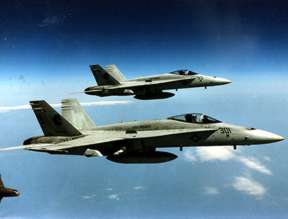
The McDonnell Douglas (later Boeing) F/A-18 Hornet is a twin-engine, carrier-capable combat aircraft developed for the United States Navy and Marine Corps. Its origins lay in the lightweight fighter competition of the 1970s; the design that became the Hornet was derived from the Northrop YF-17 and developed by McDonnell Douglas as a multirole aircraft. The prototype was rolled out in 1978, and the type entered fleet service in the early 1980s.
What distinguished the Hornet was its versatility. As its F/A designation suggests, a single airframe could be configured for both fighter (air-to-air) and attack (air-to-ground) missions, allowing it to replace several earlier aircraft on Navy carriers, including roles previously filled by the F-4 Phantom II and the A-7 Corsair II. Twin engines, modern avionics, and a flexible weapons loadout made it a dependable workhorse.
The Hornet went on to serve in numerous conflicts and with several allied air arms, including Canada, Australia, and others. Its success led to the larger, more capable F/A-18E/F Super Hornet, which entered service in the late 1990s and remains a backbone of U.S. naval aviation.