Washington Naval Convention
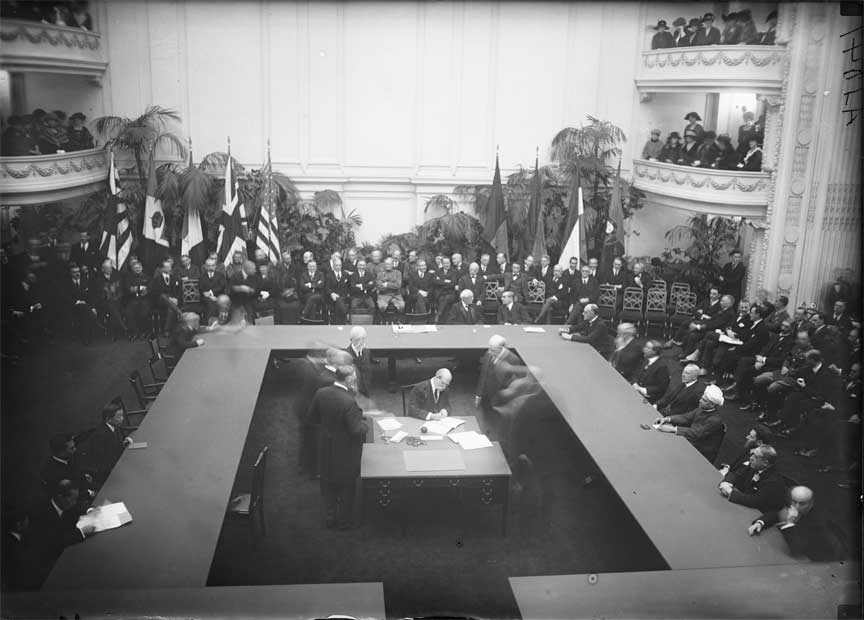
The United States, Britain, Japan, France and Italy met and agreed on a treaty limiting naval powers. The treaty called for a ratio of naval ships of 5 to 5 to 3 to 1.7 to 1.7. Thus, for every 5 large ships of the US and Britain, Japan could have 3 and France and Italy 1.7. The United States agreed to scuttle 30 war ships as a result of the treaty.
The Washington Naval Conference was preceded by a four-power treaty signed by the United States, Britain, Japan, and France. It committed each party to respect the other's rights vis-a-vis island possessions in the Pacific. They agreed to refer any dispute to a conference of the four powers.
The London Conference almost broke down over the United States' demand that Japan accept a ratio of 3 ships for every 5 American or every 5 British ships. Japan insisted on a 10 to 7 ratio. Finally, Japan accepted after the United States agreed not to fortify any Pacific islands except the Hawaiian Islands.
The French and the Italians were allotted 1.7 war ships for every 5 British and every 5 American war ships. The Italians accepted, but the French objected. Finally, after a direct appeal to the French Prime Minister, the French accepted, but only for cruisers and battleships.