From Early Computer Programming to AI-Assisted Coding
How software development evolved from paper algorithms and punch cards to assistants that write code alongside you

Software's beginnings were quite odd: the first program was written for a computer that didn't exist yet. Ada Lovelace drafted her algorithm for Charles Babbage's Analytical Engine in the 1840s, a machine that never got past blueprints, working out on paper how it would calculate Bernoulli numbers for a device she'd likely never see running.
And now we've reached (or surpassed) AI in software development… But let's see how it all evolved and what we could expect next.
Machine Code and Punch Cards
The next hundred years didn't move much faster. Programming the ENIAC in the 1940s meant crews physically rerouting cables, rebuilding the machine's wiring for every new task. Punch cards eventually replaced that, encoding instructions as patterns of holes in stiff paper, the first time "writing" a program looked more like writing than plumbing.
The Birth of Programming Languages
Rewiring a machine by hand doesn't scale past a handful of engineers, so the industry went looking for something closer to a language people could actually read.
FORTRAN and COBOL Make Code Readable
FORTRAN showed up in 1957, COBOL two years later, letting programmers write something like "add x to y" instead of feeding a machine raw binary. That shift opened programming to people who weren't trained electrical engineers, turning it into something closer to a trade.
Structured Programming Takes Over
By the 1970s, C and Pascal introduced loops, functions, and conditionals arranged with real discipline, since programs creeping from twenty lines toward thousands collapse into spaghetti fast without it.
The Object-Oriented Revolution
Bigger programs eventually demanded a new mental model, not just tighter rules.
From Smalltalk to Java
Smalltalk floated the idea of "objects" in the 1970s, bundles of data and behavior instead of a long list of steps, but it didn't catch on until C++ and later Java carried the concept mainstream.
A developer wasn't writing "step one, step two" anymore; they were building a "Car" object or a "User" object, each with its own properties and methods.
Why It Changed Team-Based Development
That reframing solved a problem languages alone couldn't: how do dozens of engineers work on one system without stepping on each other? Objects let teams split a codebase into modular pieces built and tested independently, groundwork still visible in nearly every app running today.
The Internet Era and Open Source
Once code itself was organized, the next big question stopped being how software got written and started being where it lived.
The Web as a New Platform
The Internet took software off single machines and put it in front of anyone with a browser. HTML and JavaScript made pages interactive; PHP and later Ruby on Rails made whole applications running in a browser tab realistic.
Open Source Changes the Rules
Linux proved something not obvious at the time: a serious operating system could be built by volunteers scattered across the planet, coordinating mostly through mailing lists.
GitHub later turned that instinct into daily practice. Code stopped being locked in a company vault and became something people showed each other, forked, and improved in public.
Agile, DevOps, and the Cloud
With that many more people touching the same code, the old way of managing a project stopped making sense.
From Waterfall Approach to Agile Sprints
The old "waterfall" approach (plan the entire project up front, then build start to finish) assumed nothing would change along the way. It usually did. Agile replaced that with short sprints and constant check-ins, treating a plan as a rough draft, not a contract.
The Cloud Changed Deployment Forever
Cloud platforms like AWS, Google Cloud, and Azure meant infrastructure became something you could script, not physically install. Paired with CI/CD pipelines, software went from shipping once a year on a disc to shipping dozens of times a day.
The AI-Assisted Coding Era
Readable languages, modular objects, open collaboration, pipelines that deploy on command: that groundwork is what made the next leap possible, software that writes some of itself.
From Autocomplete to AI Pair Programmers
GitHub Copilot is usually credited with putting AI-assisted coding on the map, suggesting whole lines or functions as a developer typed.
That started as glorified autocomplete and has turned into something closer to a pair programmer, one that reads surrounding code and writes chunks that actually fit the project.
Agentic Coding Takes It Further
The latest tools go a step past suggestion. So-called "agentic" assistants can open an entire repository, edit multiple files, run the test suite, and keep iterating with little hand-holding—a real jump from finishing one line to executing a whole task.
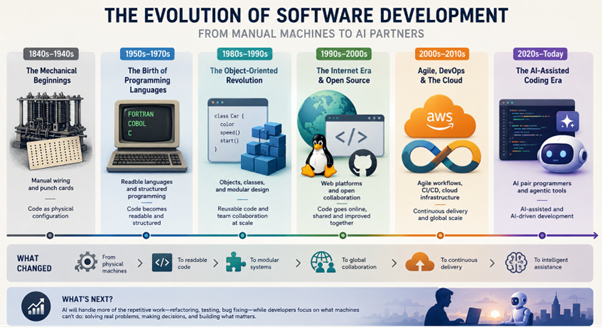
In addition, here's a table to sum up our perspectives.
| Era | Key Technology | What Changed |
|---|---|---|
| 1840s–1940s | Manual wiring, punch cards | Code as physical configuration |
| 1950s–1970s | FORTRAN, COBOL, C | Code becomes readable and structured |
| 1980s–1990s | C++, Java, Smalltalk | Object-oriented, reusable design |
| 1990s–2000s | HTML, JavaScript, Linux, GitHub | Web-based, collaborative development |
| 2000s–2010s | Agile, AWS, CI/CD | Continuous, cloud-native delivery |
| 2020s–today | Copilot, Claude, agentic coding tools | AI-assisted and AI-driven development |
What's Next for Software Development
Look back across nearly two centuries of this story, and a pattern shows up again and again: none of these shifts replaced developers; they just moved the work somewhere else. Punch cards gave way to readable syntax. Manual memory management gave way to higher-level languages. Manual deployment gave way to pipelines that run themselves.
Now, AI-assisted coding reads like the next chapter in that story.
What probably comes next isn't AI dreaming up software from a blank page. It's AI absorbing more of the repetitive grind, refactoring, testing, and chasing bugs, while developers spend more time on the calls a machine still can't make: what to build, why it matters, and whether the tradeoffs are worth it.
The tools will get faster, but we're still not seeing a future where humans are completely replaced in the field of programming.