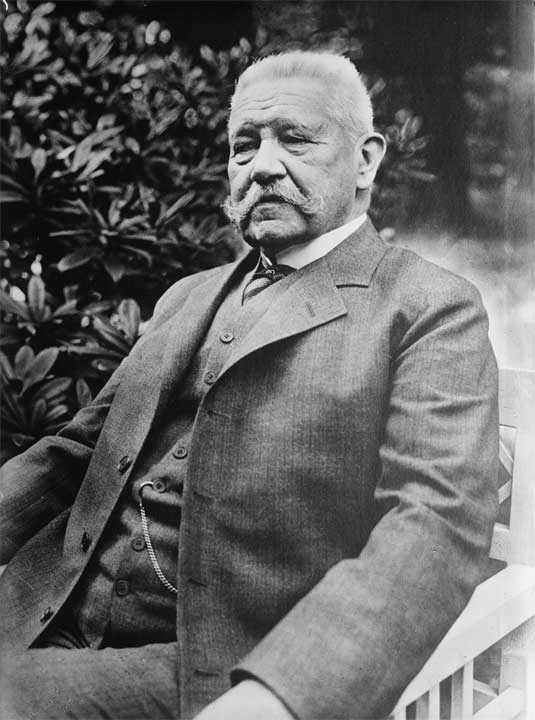
Paul von Hindenburg was the German field marshal and president whose long career bridged the empire, the First World War, and the rise of Adolf Hitler. Born into a Prussian military family, he fought as a young officer in the wars that unified Germany and then retired, only to be recalled to duty in 1914 at the outbreak of the First World War.
Together with his chief of staff Erich Ludendorff, Hindenburg won a spectacular victory over the Russians at the Battle of Tannenberg in 1914, a triumph that made him a national hero. As the war went on, the two men effectively took control of the German war effort, running the country as a virtual military dictatorship until the German collapse in 1918.
Revered by conservatives as a symbol of old Prussian honor, Hindenburg was persuaded to come out of retirement again and was elected president of the Weimar Republic in 1925. An aged and increasingly frail figure, he presided over the fragile democracy as it sank into the economic and political crises of the early 1930s.
His most fateful act came in January 1933, when, against his own instincts and the urging of advisers, the eighty-five-year-old president appointed Adolf Hitler chancellor of Germany, believing the Nazi leader could be controlled. Hindenburg's prestige lent legitimacy to the new regime, and when he died in 1934, Hitler swept away the presidency and seized absolute power.