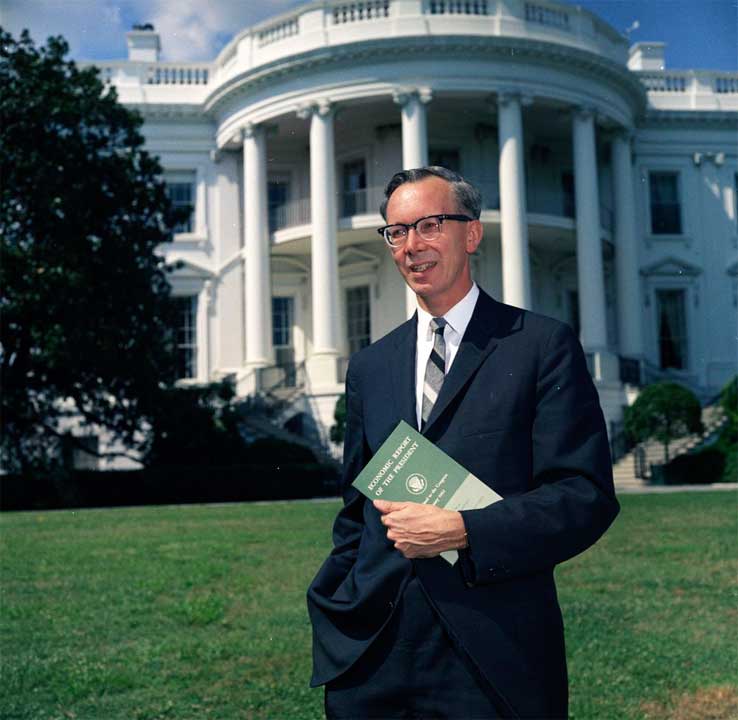
Walter Heller was an influential American economist who, as chairman of the Council of Economic Advisers under Presidents Kennedy and Johnson, helped bring Keynesian economic ideas to the center of national policy. Born in Buffalo, New York, he was trained as an economist and built a distinguished academic career, becoming a professor at the University of Minnesota and an authority on public finance and taxation.
Appointed to chair the Council of Economic Advisers in 1961, Heller became one of the most persuasive economic voices in Washington. A committed Keynesian, he argued that the federal government could and should manage the economy actively to promote growth and full employment, using fiscal policy as a deliberate tool.
His signature achievement was persuading a skeptical President Kennedy to embrace a major tax cut as a means of stimulating a sluggish economy — the idea that the government should deliberately run a deficit to spur growth. Enacted after Kennedy's death, the tax cut of 1964 was followed by a strong expansion, and it was hailed as a vindication of the "new economics."
Heller also helped shape the early planning of President Johnson's "War on Poverty" and popularized the concept of revenue sharing between the federal government and the states. After leaving government he returned to teaching and writing, remaining a prominent commentator on economic affairs until his death in 1987.