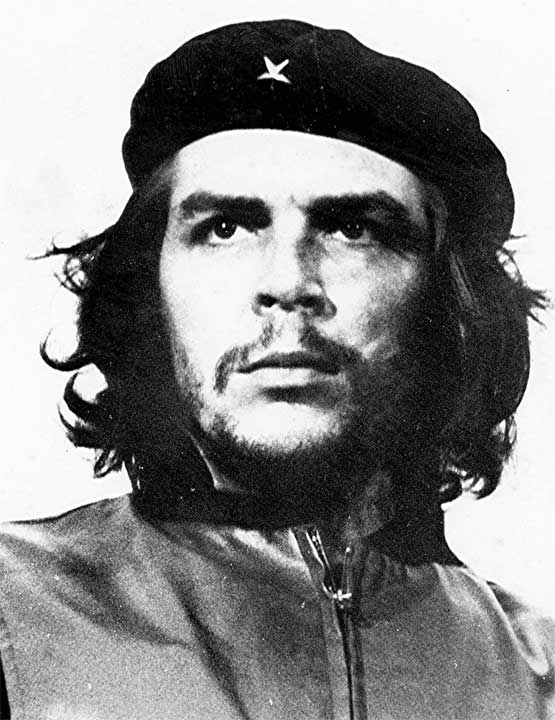
Ernesto "Che" Guevara was the Argentine-born Marxist revolutionary whose defiant image became one of the most reproduced and recognizable symbols of the twentieth century. Born into a middle-class family in Rosario, Argentina, he trained as a physician, but a youthful motorcycle journey across South America — later recounted in his Motorcycle Diaries — exposed him to poverty and injustice that convinced him only armed revolution could bring change.
In Mexico City he fell in with Fidel Castro and the small band of exiles who sailed to Cuba aboard the yacht Granma in 1956. Guevara proved a brave, disciplined, and ruthless guerrilla commander in the war that toppled the Batista dictatorship in 1959. In the new revolutionary government he held powerful posts — running the national bank and the ministry of industry — and helped steer Cuba toward a centralized socialist economy and alliance with the Soviet Union, while his writings on guerrilla warfare gained worldwide influence.
Restless and uncompromising, dreaming of igniting revolution across the developing world, Guevara left Cuba in the mid-1960s to lead insurgencies abroad, first in the Congo and then in Bolivia.
In the Bolivian highlands his small guerrilla band was hunted down by the army, advised by the CIA. Captured in October 1967, he was executed the next day. His death at thirty-nine turned him into a martyr, and his stylized portrait became an enduring emblem of rebellion the world over.