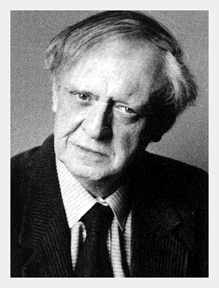
Anthony Burgess was a prolific and dazzlingly inventive English novelist, critic, and composer, best remembered as the author of the dystopian novel A Clockwork Orange. Born in Manchester, he was raised a Roman Catholic, a faith whose questions of free will, sin, and grace would echo through his fiction. He served in the army during the Second World War and afterward worked as a teacher and colonial education officer in Malaya and Borneo.
His literary career began in earnest after a doctor, mistakenly, told him he had only a year to live; determined to provide for his wife, he wrote feverishly, and a torrent of books followed over the following decades. A writer of enormous range and erudition, he produced more than thirty novels along with criticism, screenplays, journalism, and musical compositions.
His most famous work, A Clockwork Orange (1962), set in a violent near-future, tells the story of a young delinquent subjected to a sinister state program of behavioral conditioning. Written in a startling invented teenage slang and raising disturbing questions about violence, free will, and the power of the state, it became a modern classic, especially after Stanley Kubrick's controversial 1971 film adaptation.
Burgess often felt the book overshadowed his other work, which included the acclaimed Enderby novels and the panoramic Earthly Powers. A restless polymath who also composed symphonies and wrote about language and literature, he spent his later life abroad and continued writing until his death in 1993.