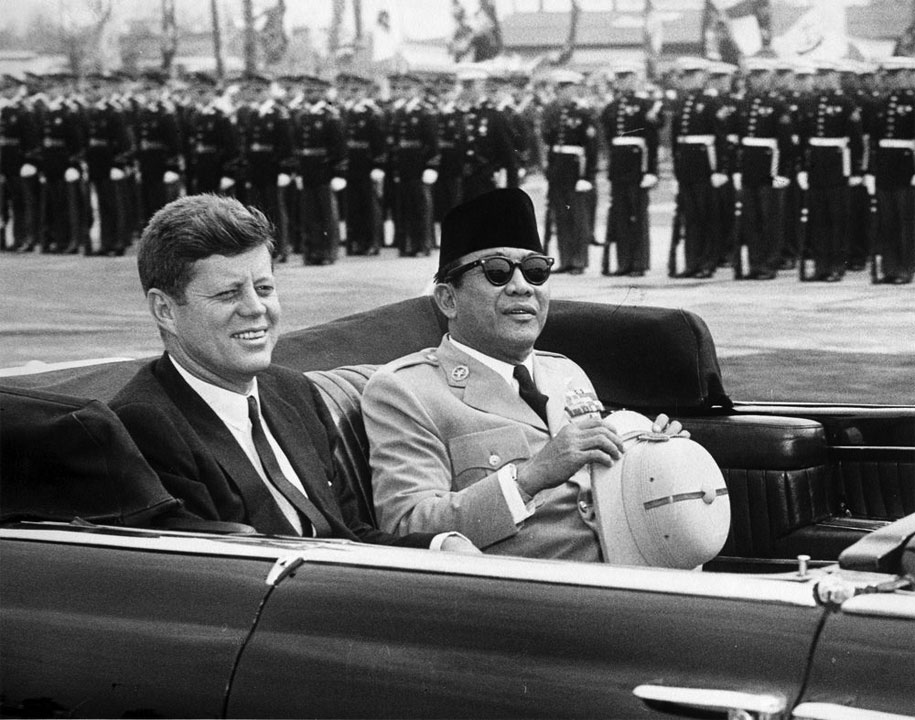
Sukarno was the founding father and first president of Indonesia, the charismatic nationalist leader who united a sprawling archipelago of hundreds of islands into a single nation and led it to independence from Dutch colonial rule. Born in Java and educated in Dutch schools, he trained as an engineer but was drawn into the struggle against colonialism, becoming the most powerful voice of Indonesian nationalism in the 1920s and 1930s.
His agitation brought years of imprisonment and exile at the hands of the Dutch authorities. During the Second World War, when Japan occupied the islands, Sukarno cooperated with the occupiers as a means of advancing the nationalist cause, and when Japan surrendered in 1945 he seized the moment to proclaim Indonesian independence.
After a bitter four-year armed struggle, the Dutch finally recognized the new republic in 1949, with Sukarno as its president. A spellbinding orator, he sought to hold his diverse country together through a national ideology he called Pancasila and presided over the landmark 1955 Bandung Conference of newly independent Asian and African states, becoming a leading figure of the non-aligned world.
In his later years Sukarno turned increasingly authoritarian, proclaiming "Guided Democracy" and balancing precariously between the army and the large Communist Party. In 1965 a murky coup and a massive anti-communist bloodbath shattered his rule; power passed to General Suharto, and Sukarno was eased aside, dying under house arrest in 1970.