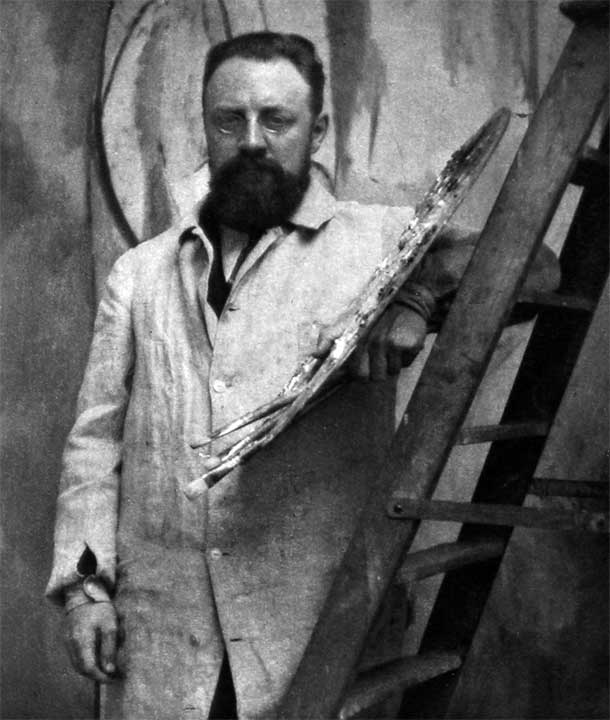
Henri Matisse was one of the greatest artists of the twentieth century, a master of color and form whose joyous, decorative paintings stand alongside Picasso's as a foundation of modern art. Born in northern France, he came to art late, abandoning a career in law after discovering painting while recovering from an illness.
Around 1905 Matisse led a group of young painters whose canvases blazed with bold, arbitrary, non-naturalistic color, applied in flat, expressive patches. Critics derided them as "les Fauves" — the wild beasts — but Fauvism announced a new freedom in art, and Matisse emerged as the leader of the avant-garde. For the next half century he pursued a lifelong quest to express feeling through pure color, simplified line, and harmonious design.
His sensuous paintings of interiors, odalisques, windows, and the human figure, radiant with Mediterranean light, made him, with Picasso, one of the two giants of modern painting — the two were lifelong rivals and mutual admirers.
In his final years, confined to a wheelchair and unable to stand at an easel, Matisse achieved a last burst of creativity with his famous "cut-outs" — vibrant compositions made by cutting shapes from painted paper — and designed the luminous Chapel of the Rosary at Vence, which he considered his masterpiece. He died in 1954, his work an enduring testament to beauty and joy.