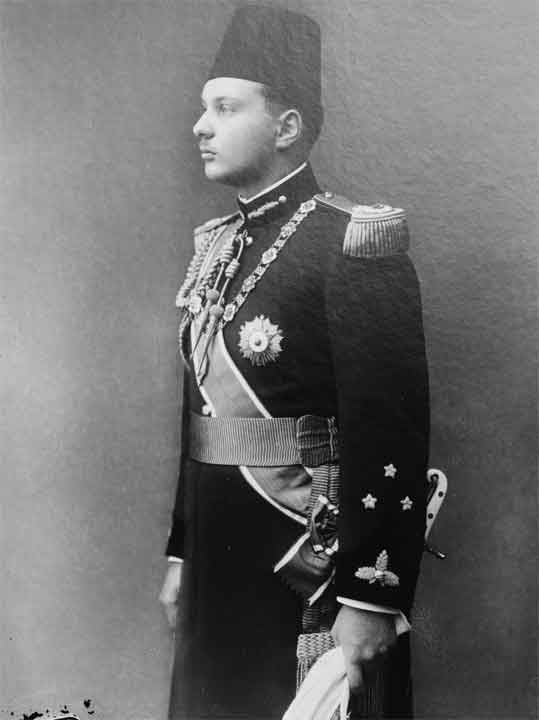
Farouk was the last effective king of Egypt, a young monarch whose reign began amid great popular hope and ended in scandal, humiliation, and revolution. Born in Cairo into the dynasty founded by Muhammad Ali, he succeeded to the throne in 1936 at the age of sixteen, on the death of his father, and was at first greeted with enthusiasm as a handsome, promising ruler.
His reign, however, was shadowed by the overbearing presence of Britain, which still dominated Egypt and its vital Suez Canal. During the Second World War the British forced Farouk to accept a government of their choosing, a humiliation that damaged his prestige and exposed the limits of Egyptian independence.
Over the years Farouk grew notorious for his extravagance, self-indulgence, and corruption. His lavish spending, gambling, womanizing, and vast appetite became legendary, even as ordinary Egyptians endured poverty, and his government was widely seen as decadent and ineffective. The Egyptian army's poor showing in the 1948 war against the new state of Israel further discredited his rule.
In 1952 a group of nationalist officers, the Free Officers led by Gamal Abdel Nasser, overthrew the monarchy in a coup. Farouk was forced to abdicate and sail into exile, reportedly remarking that soon only five kings would be left — the four in a deck of cards and the king of England. He lived out his days in Europe and died in Rome in 1965.