The Assault on Brécourt Manor
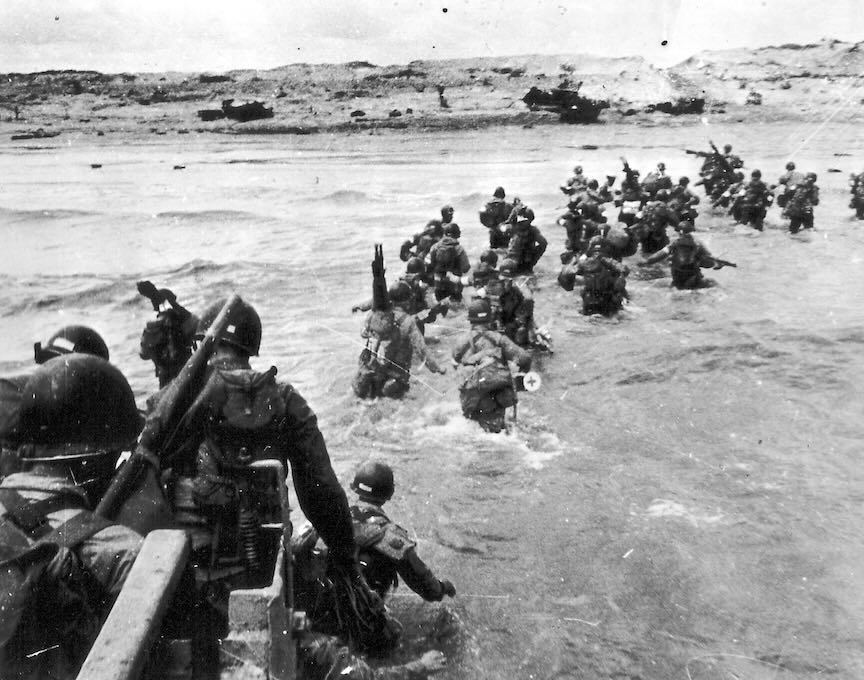
On the morning of June 6, 1944, thousands of Allied troops fought their way onto the beaches of Normandy. Behind the hedgerows near Sainte-Marie-du-Mont, however, a small group of American paratroopers was preparing to carry out one of the most famous small-unit assaults of World War II. Paratroopers from Easy Company, 506th Parachute Infantry Regiment, faced four German 105mm artillery guns overlooking Utah Beach. The battery was shelling the American landing zones and threatening the exits from the beach. The success of the Brecourt Manor assault helped secure those vital causeways and likely saved many lives during the D-Day invasion.
Led by First Lieutenant Richard Winters, the assault became a textbook example of initiative, leadership, and battlefield tactics under extreme pressure. Today, the Brecourt Manor assault is widely cited and has been used as a case study at West Point and other U.S. military schools. It is also remembered by millions through HBO’s Band of Brothers. This article explores the battle itself, the men who fought it, its military legacy, and what visitors can still discover at the site today.
The strategic objective: why Brecourt Manor had to fall the german gun network at Sainte-Marie-du-Mont
Brecourt Manor was located just inland from Utah Beach, near the village of Sainte-Marie-du-Mont in Normandy. The German position consisted of four 105mm howitzers connected by a trench system running through thick Norman hedgerows. These guns belonged to the German artillery defenses behind the Atlantic Wall and had a direct line of fire toward the causeways leading off Utah Beach.
The hedgerow terrain made the position particularly dangerous. High earthen banks and dense vegetation provided concealment for German troops while restricting visibility and movement for attacking forces. Machine gun nests protected the artillery positions, and the trenches allowed defenders to move between the guns while staying under cover.
Although the guns were not located directly inside the manor itself, the surrounding fields and trench network near Brecourt Manor became one of the most strategically important points in the early hours of D-Day.
Utah Beach was one of the five landing beaches targeted during Operation Overlord. Thousands of American troops, vehicles, and supplies were arriving on shore throughout the morning of June 6. The German artillery battery at Brecourt Manor posed a serious threat to the beach exits and inland advance routes.
If the guns remained operational, they could continue shelling the narrow causeways crossing the flooded fields behind Utah Beach. These exits were essential for moving Allied forces inland, and a prolonged artillery barrage risked slowing the American advance and increasing casualties during a critical phase of the invasion.
Neutralizing the battery quickly became a top priority for airborne troops operating behind enemy lines.
The assault: how a small unit silenced four german guns
Lt. Winters’ tactical plan: fire, move, flank
Lieutenant Richard Winters had only a small group of men available when he located the German battery. Despite being heavily outnumbered and lacking full intelligence about enemy strength, Winters devised a simple but highly effective tactical plan based on fire and movement. Winters initially assembled roughly a dozen men from Easy Company, and the assault force grew to around twenty-plus paratroopers as reinforcements arrived during the fight.
Rather than launching a frontal assault across open ground, Winters divided his men into small teams. One element provided suppressive fire while another flanked the trench system, with the goal of moving down the trench line methodically and clearing each gun position one at a time.
The assault demonstrated several core infantry principles still taught in military education today:
The plan allowed Easy Company’s men to exploit the weaknesses of the German defensive layout while minimizing their own exposure.
The assault began with American paratroopers opening fire on the first German position. Winters and his men moved quickly through the hedgerows before entering the trench network.
The first gun was disabled using explosives placed directly on the artillery piece. As Easy Company advanced down the trench, they encountered heavy resistance from German defenders firing machine guns and rifles from prepared positions.
The second gun proved especially dangerous. Intense German fire pinned down several American soldiers before Winters coordinated another flanking maneuver that allowed his men to close in on the position. Despite the chaos, the attackers maintained momentum and successfully destroyed the second artillery piece.
The battle became increasingly brutal as the men moved toward the third and fourth guns. Fighting occurred at extremely close range inside the trenches, often at grenade‑throwing distance. Several members of Easy Company were wounded during the assault.
By the end of the attack, all four guns had been silenced. Perhaps equally important, Winters recovered German maps and intelligence documents. These revealed additional enemy artillery positions in the Utah Beach sector, information that could be passed up the chain of command to assist follow‑on operations.
The role of Easy Company’s non-commissioned officers
The success of the Brecourt Manor assault was not solely due to Winters’ leadership. Easy Company’s non-commissioned officers played a decisive role during the battle.
Men such as Carwood Lipton, William “Wild Bill” Guarnere, and other NCOs demonstrated initiative under fire by organizing movements, maintaining suppressive fire, and adapting to changing battlefield conditions. Their ability to act independently inside the trench system helped maintain the assault’s momentum despite casualties and confusion.
The battle became a classic example of how disciplined small-unit leadership and empowered NCOs can overcome a larger, entrenched defensive position.
Aftermath, medals, and the battle’s lasting military legacy
Medals awarded after the Brecourt Manor action
The assault at Brecourt Manor quickly became recognized as one of the most effective small-unit actions of D-Day. Lieutenant Richard Winters received the Distinguished Service Cross, the United States Army’s second-highest award for valor. Many historians and veterans later argued that his actions merited the Medal of Honor. However, wartime policy at the time limited the number of Medals of Honor that could be awarded per division during the Normandy campaign.
Several other members of Easy Company also received decorations for bravery during the attack, including Silver Stars and Bronze Stars for key participants. The battle came at a cost: Easy Company suffered killed and wounded during the assault. German losses, meanwhile, included dead, wounded, and captured soldiers defending the battery.
Why the Brecourt Manor assault Is still studied
More than 80 years later, the Brecourt Manor assault remains a widely cited case study in infantry tactics and leadership. It has been used in instruction at the United States Military Academy at West Point and other U.S. military schools. It illustrates indeed timeless tactical principles:
● and aggressive exploitation of enemy weaknesses.
The battle is often considered a near-perfect example of how a small force can defeat a larger, entrenched enemy position through superior tactics and coordination. Modern infantry officers still study Winters’ decisions as part of battlefield leadership training and discussions of mission command.
The HBO miniseries Band of Brothers introduced the Brecourt Manor assault to a global audience. Episode 2, “Day of Days,” recreates the battle in dramatic detail and follows Winters as he leads Easy Company against the German artillery battery. Historians generally consider the depiction remarkably accurate compared to many other World War II dramatizations, particularly in the way it shows the assault proceeding gun by gun along the trench.
While some details were simplified or compressed for television—such as the exact duration of the fight and the number of men involved—the core tactical sequence and the intensity of the fighting closely match historical accounts from surviving Easy Company veterans. For many visitors today, Band of Brothers serves as the gateway to discovering the real history of Brecourt Manor.
Visiting Brecourt Manor today: what to see and how to get there
The site today: what remains of the assault area
Today, Brecourt Manor remains a place of quiet reflection in the Normandy countryside. Although the battlefield has changed since 1944, visitors can still identify many elements of the original terrain:
● and the general landscape crossed by Easy Company during the assault.
Most of the former gun line lies on private farmland, so the battlefield is mainly viewed from nearby roads and memorial points rather than by walking through the trenches themselves.
Several memorial markers commemorate the battle and the men who fought there. The peaceful atmosphere of the site contrasts sharply with the violence of the events that unfolded on D-Day morning. Unlike larger museums or memorial complexes, Brecourt Manor retains a relatively authentic rural setting, which helps visitors better understand the tactical challenges posed by hedgerows and fields in 1944.
Practical visit information: location, access, and nearby attractions
Brecourt Manor is located near Sainte-Marie-du-Mont in Normandy, only a short drive from Utah Beach and the Utah Beach Landing Museum . The site can easily be combined with other major D-Day locations, including :
● and the Normandy American Cemetery overlooking Omaha Beach.
Many travelers choose to visit the area as part of a guided D-Day tour to better understand the tactical significance of the assault and the movements of Easy Company throughout June 6, 1944. Because the manor and the fields where the guns once stood are private, working farm property, visitors should remain on public roads and at marked memorial areas, and avoid entering fields without the owner’s permission.
The Brecourt Manor assault remains one of the most studied and admired small-unit actions in American military history. On June 6, 1944, a small group of paratroopers led by Lieutenant Richard Winters faced a well-prepared German artillery position in the Norman hedgerows near Sainte-Marie-du-Mont and succeeded in eliminating a major threat to the Utah Beach landings.
Beyond its tactical brilliance, the battle endures because of the human story behind it: leadership, initiative, courage, and teamwork under seemingly impossible conditions. Today, the fields around Brecourt Manor continue to attract historians, military professionals, Band of Brothers fans, and D-Day travelers from around the world. Walking the ground—at least from the roads and memorial points where visitors are allowed—offers a powerful reminder of the sacrifices made during the liberation of Europe.
For visitors exploring Normandy’s D-Day history, few sites capture the intensity and significance of airborne operations on June 6, 1944, more vividly than Brecourt Manor.