 >
>
USS Missouri BB-11
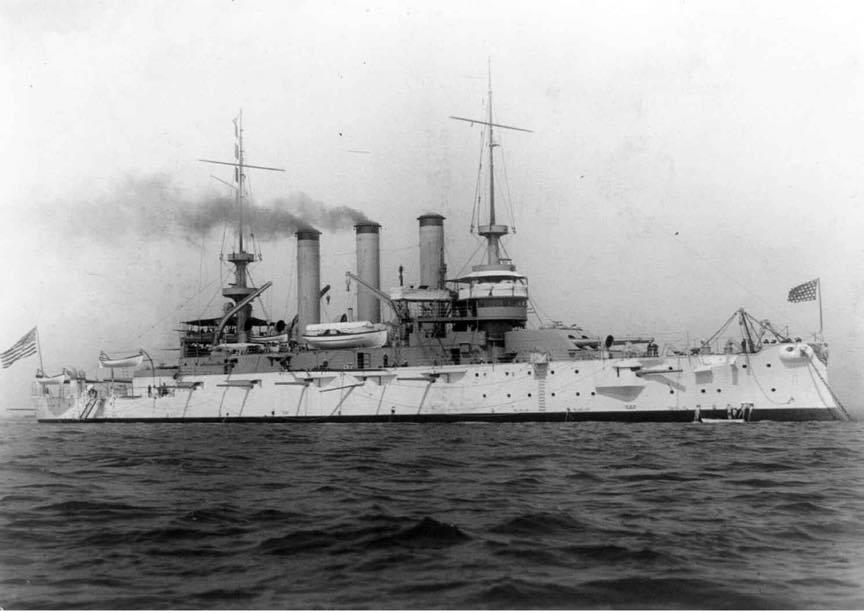
The third Missouri (BB-11), with a displacement of 13,500 tons, a length of 393 feet 11 inches, a beam of 72 feet 2 inches, a draft of 25 feet 8 inches, and a speed of 18.15 knots, was laid down by the Newport News Shipbuilding & Drydock Co., Newport News, Virginia, on 7 February 1900. Launched on 28 December 1901, she was sponsored by Mrs. Edson Gallaudet, daughter of Senator Francis Marion Cockrell of Missouri, and commissioned on 1 December 1903, with Captain William S. Cowles in command.
Assigned to the North Atlantic Fleet, Missouri departed Norfolk on 4 February 1904 for trials off the Virginia Capes and fleet operations in the Caribbean. On 13 April, during target practice, a flareback from the port gun in her after turret ignited a powder charge, setting off two others. Although no explosion occurred, the rapid burning of the powder suffocated 36 crew members. Prompt action prevented the loss of the warship, and three crew members were awarded Medals of Honor for extraordinary heroism. After repairs at Newport News, Missouri sailed on 9 June for duty in the Mediterranean, returning to New York on 17 December.
Fleet operations along the East Coast and in the Caribbean during the next few years included providing relief to earthquake victims in Kingston, Jamaica, from 17 to 19 January 1907. In April, she participated in the Jamestown Exposition.
With the "Great White Fleet," Missouri sailed from Hampton Roads on 16 December 1907, passing in review before President Theodore Roosevelt at the start of a world cruise demonstrating American naval might. The fleet visited ports in the Caribbean, along the South American east coast, rounded Cape Horn, and stopped in Peru and Mexico before arriving in San Francisco in May 1908 for a gala visit. In July, the fleet sailed west to Honolulu, New Zealand, and Australia, reaching Manila on 2 October. After receiving a tumultuous welcome in Yokohama and visiting Amoy, China, the fleet began its homeward journey via Ceylon, the Suez, and ports in the Eastern Mediterranean. Departing Gibraltar on 6 February 1909, the fleet was again reviewed by President Roosevelt upon its triumphant return to Hampton Roads on 22 February, having successfully completed an important diplomatic mission.
Missouri was placed in reserve at Boston on 1 May 1910, recommissioned on 1 June 1911, and resumed East Coast and Caribbean operations with the Atlantic Fleet. In June 1912, she transported marines from New York to Cuba to protect American interests during a rebellion. The following month, she carried midshipmen for training, then decommissioned at Philadelphia on 9 September 1912.
Recommissioned on 16 March 1914, Missouri joined that summer's Naval Academy Practice Squadron's cruise to Italian and English ports, returning to ordinary at Philadelphia on 2 December 1914. She recommissioned on 15 April 1915 for midshipmen training in the Caribbean and a cruise through the Panama Canal to California ports. She returned to the Reserve Fleet at Philadelphia on 18 October 1915, recommissioned on 2 May 1916, and conducted training along the East Coast and in the Caribbean until placed in ordinary for the winter at Philadelphia.
Upon the United States' entry into World War I, Missouri recommissioned on 23 April 1917, joined the Atlantic Fleet at Yorktown, Virginia, and served as a training ship in the Chesapeake Bay area. On 26 August 1917, Rear Admiral Hugh Rodman hoisted his flag on Missouri as Commander, Division 2, Atlantic Fleet. The warship continued training thousands of recruits in engineering and gunnery for foreign service on warships and as armed guards for merchant vessels.
Following the Armistice, the battleship joined the Cruiser and Transport Force, departing Norfolk on 18 February 1919 on the first of four voyages to Brest to return 3,278 U.S. troops to East Coast ports. Missouri decommissioned at the Philadelphia Navy Yard on 8 September 1919. She was sold to J. G. Hitner and W.F. Cutler of Philadelphia on 26 January 1922 and scrapped in accordance with the treaty limiting naval armaments.