371932
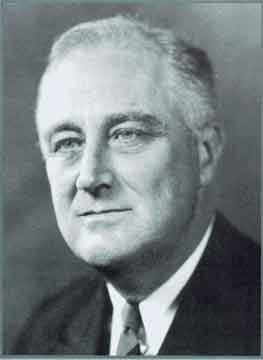
portrait — Franklin D. Roosevelt
Presidential Election · 1932
The Election of 1932
Franklin D. Roosevelt defeats Herbert Hoover
Amid the Great Depression, FDR sweeps Hoover from office and launches the New Deal.
Democratic VictoryFranklin D. Roosevelt defeats Herbert Hoover
Amid the Great Depression, FDR sweeps Hoover from office and launches the New Deal.
Democratic VictoryThe Result

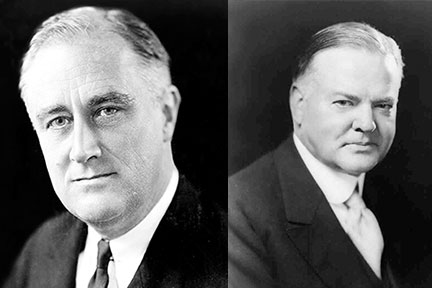

Amid the Great Depression, FDR sweeps Hoover from office and launches the New Deal.
Franklin Roosevelt's overwhelming victory in his 1930 reelection campaign for Governor set the stage for his bid for the Presidency. Roosevelt and his aids immediately began to maneuver behind the scenes to gain Roosevelt the Democratic presidential nomination. Louis Howe worked on the inside, while Jim Farley traveled the country attempting to garner support for Roosevelt. Franklin was the early favorite, but due to the Democratic convention rules that a candidate needed to receive 2/3 of the votes at the convention, a small lead was not enough.
On March 15, Governor Roosevelt officially announced he was running for the Presidency. As the convention approached, Roosevelt had the lead. His opponents included Al Smith and John Garner of Texas. The key to securing a convention victory was winning the nomination on one of the first ballots. On June 30, the first votes were cast for the nomination. Roosevelt received 666 (1/2), Smith received 203 (3/4), and Garner received 90 (1/4.) It was an impressive showing for Roosevelt. However, FDR was still 104 votes shy of the 2/3 needed to secure the nomination. Finally, on the fourth ballot, after Garner was offered the vice-presidential candidacy, Roosevelt won the presidential nomination. The next day, in a break with tradition, Roosevelt flew to Chicago to accept the nomination. Roosevelt engaged in a vigorous campaign, attacking the policies of the Hoover administration. The onset of the economic depression made the Republican position almost untenable. The Republicans had taken credit for the country’ s economic prosperity. Now, it was hard to evade responsibility for the economic depression. Roosevelt's one area of weakness was the corruption of New York's Tammany political organization. Charges of fraud had been brought against New York City's Mayor, James Walker. Roosevelt personally conducted the hearing. FDR gained important support by virtue of his resourceful handling of this investigation. The campaign took place against the background of the great economic depression. Roosevelt campaigned feverishly to prove that, despite his disability, he could vigorously undertake the position of United States President. At first, Hoover had planned to stay in the White House working during the crisis, but Roosevelt’ s ads brought Hoover out on the campaign trail. Hoover tried to depict Roosevelt as an extremist who would bring the country to ruin. Hoover’ s dour campaigning, compared to Roosevelt's more positive upbeat approach, worked against him. With 1/4 of the workforce unemployed, Roosevelt won an overwhelming victory.
The Popular Vote
The recorded popular vote in each state.
Figures as recorded by HistoryCentral.