Doolittle Wins the Schneider
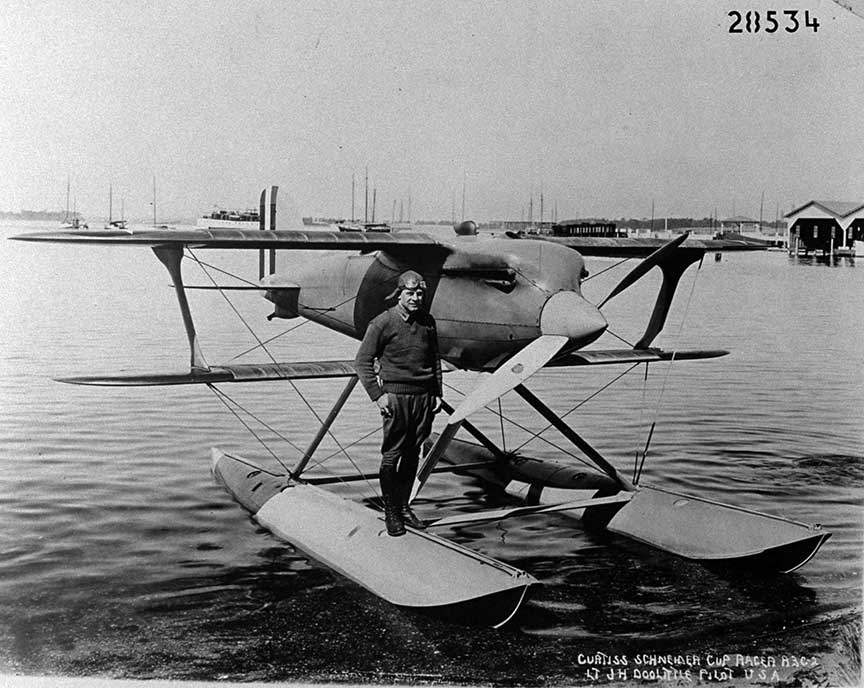
Army Lieutenant Jimmy Doolittle made history on October 26, 1925, by winning the prestigious Schneider Trophy race, an international competition for seaplanes. Flying a Curtiss R3C-2 biplane equipped with floats, Doolittle demonstrated extraordinary skill and daring as he averaged a speed of 232 miles per hour over a course set above Chesapeake Bay. His victory not only secured the trophy for the United States but also highlighted the rapid advancements in aviation technology and the growing capabilities of American pilots.
The Schneider Trophy, established in 1913 by French industrialist Jacques Schneider, was designed to encourage innovation in seaplane development. The competition attracted global interest, with nations such as Britain, Italy, and France fiercely competing to dominate the field. By 1925, the race had become a symbol of national pride and a testing ground for cutting-edge aviation technologies. Doolittle’s Curtiss R3C-2 biplane was a marvel of engineering.
Powered by a supercharged Curtiss V-1400 engine, it could reach speeds exceeding 250 miles per hour, making it one of the fastest aircraft of its time. Despite the machine’s power, piloting it required immense skill due to the high speeds, challenging maneuvering requirements, and unpredictable conditions over the open water. Doolittle’s performance in the Schneider Trophy race cemented his reputation as one of the era’s premier aviators.
The victory also underscored the importance of seaplanes in the 1920s, as these aircraft were seen as vital for both military and commercial applications due to their ability to take off and land on water. Beyond its immediate significance, the race contributed to the broader narrative of Doolittle’s illustrious career. He would go on to achieve numerous milestones in aviation, including the first outside loop in an airplane and the first blind flight using only instruments.
His achievements in the Schneider Trophy race and beyond symbolized a golden era of aviation, characterized by rapid technological progress and the unrelenting pursuit of new horizons.