Vought F7U Cutlass
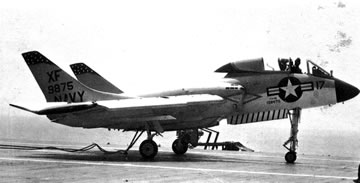
The Vought F7U Cutlass was a radical, tailless swept-wing carrier fighter and one of the most unconventional jets of its era. Drawing on captured German aerodynamic research, it dispensed with a horizontal tail, using twin fins and large trailing-edge "ailevators" for control. First flown in September 1948, it was the first U.S. Navy aircraft to combine swept wings with afterburners. The early version's Westinghouse J34 engines proved underpowered, and the production F7U-3 received Westinghouse J46 afterburning turbojets.
Despite advanced features, the Cutlass earned an unenviable reputation: its long nose landing gear and unusual handling made carrier operations hazardous, and it suffered a high accident rate, killing a number of test and fleet pilots. It served only briefly with the Navy in the mid-1950s before being withdrawn. Around 320 were built. The Cutlass is remembered as an ambitious but troubled design that pushed naval aviation into the supersonic age.
Specifications
- Manufacturer
- Vought
- Type
- Carrier-based fighter
- Crew
- 1
- First Flight
- September 29, 1948
- Powerplant
- 2 x Westinghouse J46-WE-8B turbojets, 6,000 lbf each with afterburner
- Max Speed
- 697 mph
- Range
- approx. 660 miles
- Service Ceiling
- 40,600 ft
- Length
- 43 ft 1 in
- Wingspan
- 39 ft 8 in
- Loaded Weight
- 31,600 lb (max)