North American F-100 Super Sabre
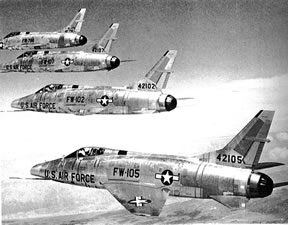
The North American F-100 Super Sabre was the world's first production aircraft capable of sustained supersonic flight in level flight, and the first of the Air Force's famous "Century Series" fighters. It made its initial flight on May 25, 1953, and North American built 2,294 of them before production ended in 1959. Designed originally as a supersonic air-superiority successor to the F-86 Sabre, the "Hun" found its true calling as a fighter-bomber and became a workhorse of the early Vietnam War, striking bridges, road junctions, river traffic and enemy troop concentrations.
It was powered by the Pratt & Whitney J57 turbojet and armed with four 20mm cannon plus a heavy load of bombs and rockets. The F-100C added in-flight refueling, underwing fuel tanks and an improved bombing system, while the definitive F-100D and two-seat F-100F served for years with the Air Force, the Air National Guard and allied air arms.
Specifications
- Manufacturer
- North American Aviation
- Type
- Supersonic fighter-bomber
- Crew
- 1
- First Flight
- May 25, 1953
- Powerplant
- Pratt & Whitney J57 turbojet with afterburner
- Max Speed
- 864 mph (Mach 1.3)
- Service Ceiling
- 50,000 ft
- Length
- 53 ft 9 in
- Wingspan
- 38 ft 9 in
- Armament
- 4 x 20mm M39 cannon; bombs and rockets