Boeing C-17 Globemaster III
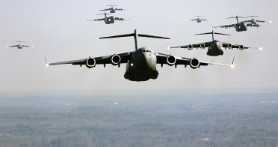
The C-17 Globemaster III is a four-engine jet airlifter originally developed by McDonnell Douglas and produced by Boeing, designed to combine strategic and tactical airlift in a single aircraft. It can carry troops and outsize cargo over intercontinental distances directly into austere forward airfields, landing on runways as short as 3,000 feet and only 90 feet wide, then reversing and maneuvering with a three-point turn. It first flew on September 15, 1991, and the first production aircraft was delivered to Charleston Air Force Base in June 1993, with the type declared operational in January 1995.
Operated by a crew of three, it carries virtually all of the Army's air-transportable equipment through a large aft cargo door, with a maximum payload near 170,900 pounds. Powered by fully reversible Pratt & Whitney F117 turbofans, the C-17 has become the core of U.S. and allied strategic airlift.
Specifications
- Manufacturer
- Boeing (originally McDonnell Douglas)
- Type
- Strategic and tactical cargo transport
- Crew
- 3 (two pilots, loadmaster)
- First Flight
- September 15, 1991
- Powerplant
- 4 x Pratt & Whitney F117-PW-100 turbofans, 40,440 lbf each
- Max Speed
- 450 knots (518 mph; Mach 0.74) at 28,000 ft
- Range
- Global with in-flight refueling; approx. 2,400 nm with 160,000 lb payload
- Service Ceiling
- 45,000 ft (13,716 m) at cruise
- Length
- 174 ft (53.0 m)
- Wingspan
- 169 ft 10 in (51.75 m) to winglet tips
- Loaded Weight
- Max takeoff 585,000 lb (265,350 kg)
- Armament
- None (unarmed transport)