Boeing B-50 Superfortress
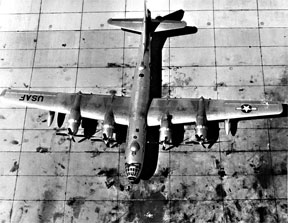
The Boeing B-50 Superfortress was a heavily improved derivative of the World War II B-29, sharing its overall layout but featuring far more powerful Pratt & Whitney R-4360 radial engines, a taller tail, and a stronger structure. Entering service in 1948, it served as Strategic Air Command's primary medium bomber in the early Cold War, carrying nuclear weapons until jet bombers took over. A B-50A named Lucky Lady II made history in 1949 as the first aircraft to fly nonstop around the world, completing the journey with aerial refueling.
As frontline bombing duties passed to jets, B-50s were converted into aerial tankers (KB-50) and weather-reconnaissance aircraft (WB-50), roles in which they served into the 1960s. The Superfortress thus bridged the piston-engine and jet eras of American strategic airpower.
Specifications
- Manufacturer
- Boeing
- Type
- Strategic medium bomber
- Crew
- 8 to 10
- First Flight
- June 25, 1947
- Powerplant
- Four Pratt & Whitney R-4360 radials, 3,500 hp each
- Max Speed
- 400 mph
- Range
- 6,000 mi
- Service Ceiling
- 40,000 ft
- Length
- 99 ft
- Wingspan
- 141 ft 3 in
- Loaded Weight
- 164,500 lb max takeoff
- Armament
- Thirteen .50-cal machine guns; up to 20,000 lb of bombs