Roe v. Wade
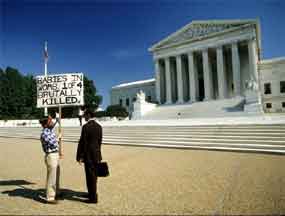
In the 1973 case of Roe v. Wade, the United States Supreme Court held that the Constitution protected a woman's right to choose to have an abortion, striking down many state laws that had criminalized the procedure. The decision, written by Justice Harry Blackmun, rested on a right of privacy that the Court found implicit in the Constitution, encompassing a woman's decision, in consultation with her physician, whether to terminate a pregnancy. The Court established a framework tied to the stages of pregnancy that balanced this right against state interests.
Roe v. Wade was one of the most consequential and contested decisions in American legal history, establishing a nationwide constitutional protection for abortion. The ruling became a defining issue in American politics, galvanizing both supporters of reproductive rights and opponents who sought to overturn it. It shaped decades of debate over privacy, women's autonomy, and the role of the courts, and remained a central reference point in the struggle over reproductive rights.