Battle of Pyramids
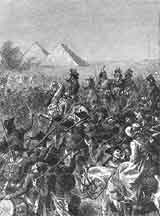
In 1798 Napoleon Bonaparte led a French expedition to Egypt, aiming to threaten British communications with India and to extend French influence in the eastern Mediterranean. Egypt was nominally part of the Ottoman Empire but was effectively dominated by the Mamluks, a warrior caste of formidable but old-fashioned cavalry.
On 21 July 1798, within sight of the pyramids of Giza, Napoleon's disciplined infantry, formed into defensive squares, decisively defeated the charging Mamluk cavalry led by Murad Bey and Ibrahim Bey at the Battle of the Pyramids. The following day French forces entered Cairo.
The victory gave France control of much of Egypt, but the campaign soon faltered. The British admiral Horatio Nelson destroyed the French fleet at the Battle of the Nile in August 1798, stranding Napoleon's army. The occupation nonetheless brought a corps of scholars who produced influential studies of Egypt and uncovered the Rosetta Stone, while the upheaval helped open the way for the rise of Muhammad Ali.