Alexander II Killed
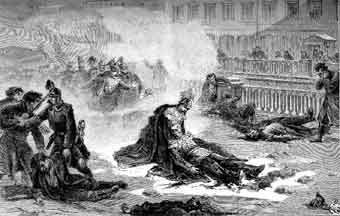
On March 13, 1881, a bomb thrown by members of the revolutionary group Narodnaya Volya (People's Will) fatally wounded Czar Alexander II in St Petersburg. He had survived several earlier attempts on his life, but on that day a second bomb was hurled as he went to aid those injured by a first explosion, mortally wounding him. He died of his wounds the same day after a reign of twenty-six years.
Alexander II had come to the throne in 1855 and earned the title 'Czar Liberator' for emancipating the serfs in 1861, along with reforms of the judiciary, local government, and the army. Yet his cautious approach disappointed radicals who sought deeper change, and revolutionary movements grew more violent during the 1870s. His assassination came on the very day he had reportedly approved tentative steps toward limited representative reform.
He was succeeded by his thirty-six-year-old son, Alexander III, who drew the opposite lesson from his father's death. Rejecting reform, the new czar pursued a reactionary course of autocracy, censorship, and repression of revolutionary groups, while promoting Russification of national minorities. The killing thus hardened the Russian state against liberalization and deepened the conflict between the autocracy and its radical opponents in the decades before 1905.