How Primary Sources Turn History from Dates into Decisions
A year on a page is inert. A letter, a photograph, a court record — those put a student inside a choice nobody knew the ending to
A student can memorize that the Great Depression began in 1929 and still have no real sense of what it felt like to live through it. The year sits there, neat and lifeless. Then that same student reads a letter from a farmer begging a federal agency for help, or studies a photograph of a family standing beside a half-empty truck on a dusty road. Suddenly, history has weather, hunger, pride, fear, and argument.
That is the quiet power of primary sources. They do not simply tell students what happened. They let students wrestle with how people saw their own world before anyone knew how the story would end.
How Primary Sources Help Students Understand History is not only a question for history teachers. It matters to anyone who wants students to read closely, argue carefully, and resist easy answers. Many learners struggle with historical writing because they treat the past as a finished script. A student looking for help with research or even searching for write my papers may not only need writing support; often, the deeper challenge is learning how evidence works. Primary sources make that challenge visible.
Primary Sources Make the Past Less Tidy
Textbooks are useful. They organize chaos. They select major events, explain causes, and give students a path through centuries of conflict, change, and invention. But that same clarity can become a problem. It can make history appear inevitable.
Primary sources interrupt that neatness.
A wartime diary, for example, may show uncertainty when the textbook presents strategy. A newspaper editorial from the 1800s may reveal assumptions that now seem shocking. A political speech might sound noble until students compare it with a law, a private letter, or a photograph of the people affected by the policy.
This friction is where real historical thinking begins. Students learn that people in the past did not walk around knowing they were “before” a revolution, “during” a turning point, or “on the wrong side” of a future moral judgment. They made choices with limited information. They defended interests. They misunderstood events. They changed their minds.
That realization helps students move beyond simple labels such as hero, villain, progress, decline. History becomes human. Messy, but human.
They Teach Students to Question Evidence
One of the most practical benefits of primary sources is that they force students to ask better questions. Not bigger questions, necessarily. Better ones.
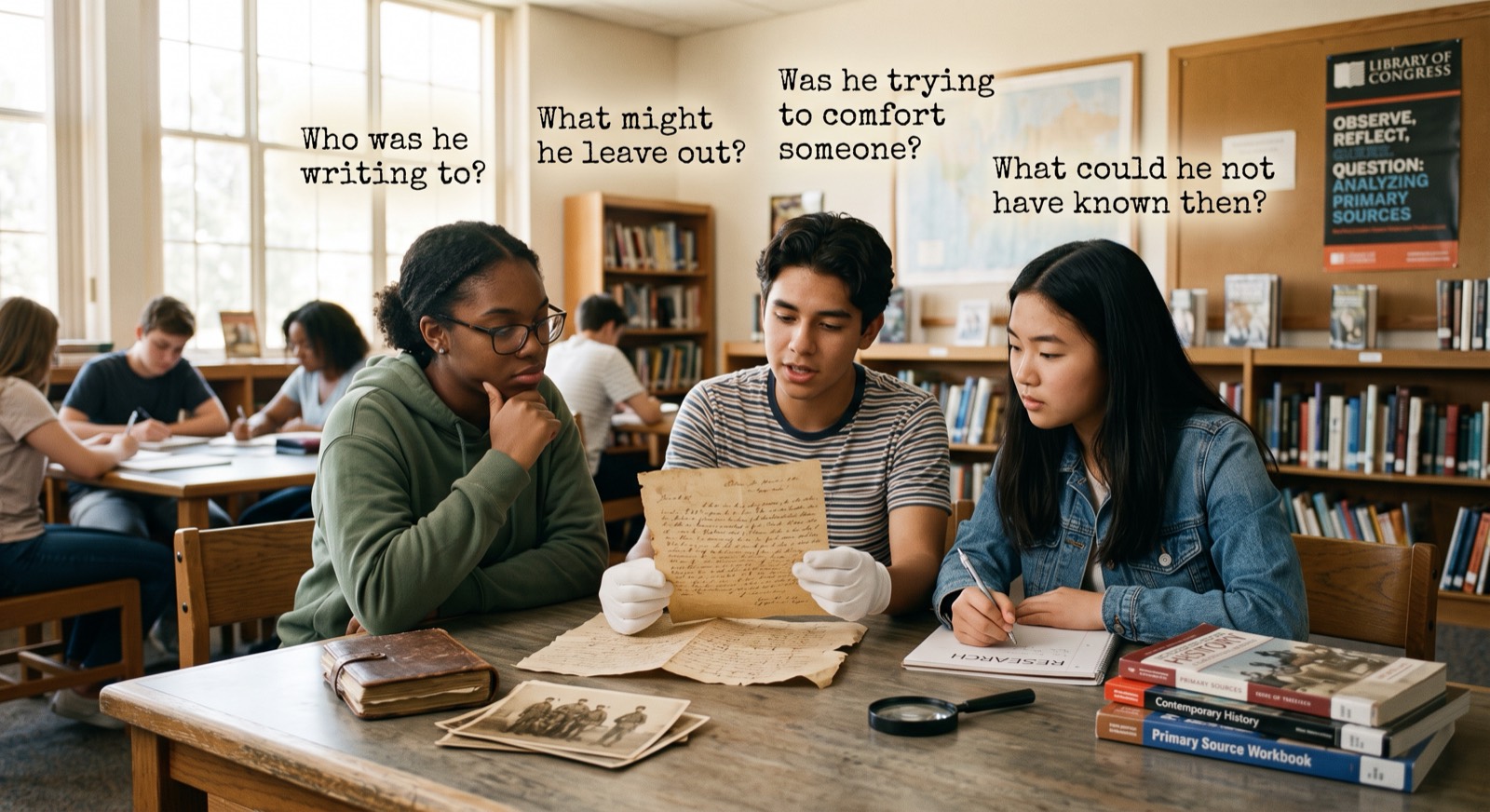
A class reading a letter from a Civil War soldier might begin with content: What does he say? But the richer work comes next. Who was he writing to? What might he leave out? Was he trying to comfort someone, persuade someone, or protect his own reputation? What could he not have known at the time?
The Library of Congress, in its teaching materials on primary sources, emphasizes observation, reflection, and questioning as core habits for analyzing historical documents. That approach works because it slows students down. Instead of racing toward an answer, they learn to sit with evidence.
Common primary sources used in classrooms include:
- letters, diaries, memoirs, and personal journals
- photographs, maps, posters, advertisements, and political cartoons
- speeches, court records, census data, laws, and government reports
- oral histories, interviews, news footage, and audio recordings
Each type asks for a slightly different kind of attention. A photograph may look objective, but framing matters. A law may seem clear, but enforcement tells another story. A diary may feel honest, but honesty is not the same as completeness.
That distinction is crucial.
Students Learn That Every Source Has a Point of View
Young writers often assume bias means a source is useless. That is a mistake. Bias is not a reason to throw a source away; it is a reason to read it more intelligently.
A campaign poster is biased. So is a soldier’s letter, a business owner’s testimony, a reformer’s pamphlet, and a monarch’s decree. The point is not to find a perfectly neutral voice from the past. There usually isn’t one. The point is to understand perspective.
Imagine students studying child labor during the Industrial Revolution. A factory owner’s statement to Parliament may stress efficiency, discipline, and wages. A reformer’s report may describe injuries, exhaustion, and moral outrage. A child worker’s testimony may reveal something neither adult source fully captures: boredom, fear, pride in earning money, resentment, or loyalty to family.
Put together, the sources do not produce a simple answer. They create a fuller picture.
This is where students start to understand that history is not just a list of facts. It is an argument built from evidence.
Primary Sources Make Writing Stronger
Students who work with original evidence tend to write with more precision. Their essays become less dependent on vague claims such as “people were angry” or “life was hard.” They can point to a bread price, a diary entry, a courtroom statement, or a photograph of a crowded tenement kitchen.
Specific evidence changes the quality of a paragraph.
A weak student sentence might say: Many immigrants faced difficulties when they arrived in America.
A stronger one might say: In an inspection record from Ellis Island, officials marked several arrivals for medical review, showing how immigration was not just a journey but a process of public judgment and control.
The second sentence gives the reader something to examine. It also opens the door to interpretation. Why were bodies inspected? Who had authority? How did immigrants experience that scrutiny?
Good history writing grows from those questions.
How Teachers Can Use Primary Sources Without Overwhelming Students
Primary sources can frustrate students when they are handed over without support. Old handwriting, unfamiliar vocabulary, missing context, and long paragraphs can turn curiosity into confusion fast. The solution is not to simplify everything. It is to design the encounter carefully.
A practical classroom sequence might look like this:
- Start with a short source, such as one paragraph, one image, or one excerpt from a speech.
- Ask students to describe what they notice before asking them to interpret it.
- Add context only after they have made initial observations.
- Pair the source with a contrasting document from another viewpoint.
- Have students write a claim that uses the source as evidence, not decoration.
That last point matters. Students often drop quotations into essays as proof without explaining them. Primary sources should not sit in a paper like museum objects behind glass. Students need to handle them. They need to explain what the evidence shows, what it does not show, and why it matters.
The Best Lessons Leave Room for Discomfort
Some primary sources are inspiring. Others are painful. Students may encounter racist advertisements, wartime propaganda, accounts of enslavement, colonial records, or laws denying basic rights. These materials require care, but avoiding them can produce a false version of the past.
The teacher’s role is to create enough structure for students to face difficult evidence without turning it into spectacle. That means preparing context, setting expectations, and helping students distinguish between studying harmful ideas and accepting them.
It also means allowing silence now and then. Not every document needs an immediate hot take. Sometimes students need a moment to absorb what a source reveals about cruelty, courage, fear, or ordinary compromise.
That pause can be educational too.
Why It Matters Beyond History Class
The routines pupils build with key resources do not remain in the background class. They learn to ask who produced a message, wherefore target market, with what intention, and under what problems. Those are civic skills. They matter when reviewing information, examining political cases, interpreting stats, or scrolling through social media.
A pupil who has actually compared contrasting accounts of a strike, a war, or a protest is much better prepared to observe when a modern-day argument conceals its presumptions. A pupil that has examined propaganda from the past might recognize psychological manipulation in today.
Primary sources do not make trainees automatically sensible. Absolutely nothing does. But they train attention. They award interest over certainty. They show that proof has texture. Most importantly, they allow trainees fulfill the past on closer terms. Not as a sleek story with all the harsh sides sanded down, yet as a world made by individuals who said, hoped, lied, suffered, adjusted, and left traces behind. History ends up being more than what occurred. It becomes something students can explore.