 >
>War of Independance The First Truce- 1948
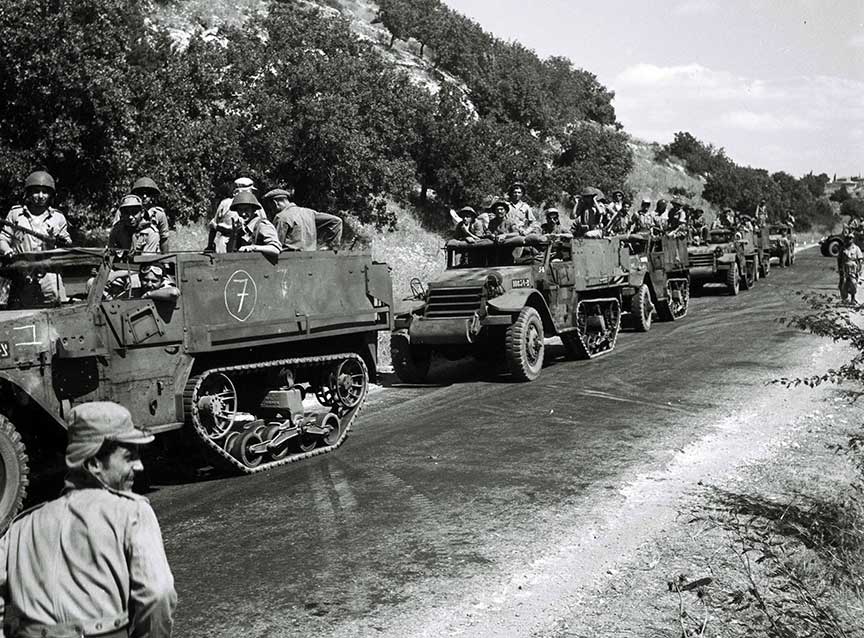
IDF Halftracks of the 8th Brigade
On May 29th, the Security Council passed a resolution calling for a four-week truce, beginning on June 1, while at the same time imposing a full arms embargo on all parties
On May 14th, the UN General Assembly voted to establish a mediator "to promote a peaceful adjustment of the future situation in Palestine." UN General Secretary Trygve Lie appointed Count Folke Bernadotte as the special mediator for Palestine on May 20th. Bernadotte, a Swedish diplomat who saved many lives during World War II, including Jews, knew nothing about the Palestine problem. Bernadotte appointed Ralph Bunche, an African American, as his deputy.
At their first meeting, Bernadotte asked Bunche, "What do they want me to do there?" Bunche answered, "To stop a war." When Bernadotte inquired, “How?” Bunche responded, "With our bare hands." Bernadotte replied, "Okay, let's go." On May 22, the Security Council called for an immediate truce. The Israelis agreed immediately, however the Arabs refused. On May 29th, the Security Council passed a resolution calling for a four-week truce, beginning on June 1, while at the same time imposing a full arms embargo on all parties.
While the Israelis were open to the truce, the Arabs showed reluctance. Many Arab leaders feared backlash if they offered the Jewish state a break. Eventually, due to their forces being depleted and lacking supplies, the Arabs all too agreed. On June 9th, a ceasefire agreed upon by both sides commenced. The ceasefire was meant to last from June 11th to July 8th, yet no firm measures were put in place to prevent either side from violating resupply restrictions.
Both parties ended up breaching the ceasefire, though Israel benefited more significantly. A senior British officer predicted that the ceasefire would be leveraged by the Israelis for military preparation and reorganization, while the Arabs would squander the pause of the ceasefire in disputes. This prediction held true. The Israeli forces swiftly expanded in numbers and armaments, including 25,000 rifles, 5,000 machine guns, and 50 million bullets, along with the arrival of heavy weaponry such as fighter planes and B-17 bombers.
By the end of the first truce, the Israeli military was notably strengthened, while the Arab forces saw minimal gains in troops, and virtually no new armaments, due to a lack of preparation for a weapons embargo.
During the truce, Bernadotte sought a permanent peace, proposing a plan granting Arabs most of the Negev in exchange for Jews receiving the Western Galilee. Jerusalem would become part of the Arab state, with Haifa Port and Lydda Airport as free ports. This plan was rejected by the Israelis, particularly due to the allocation of Jerusalem, and by the Arabs, unwilling to recognize any Jewish state. Bernadotte's effort to extend the truce failed, as the Arabs declined, despite Israeli agreement.