 >
>Civil War in Palestine
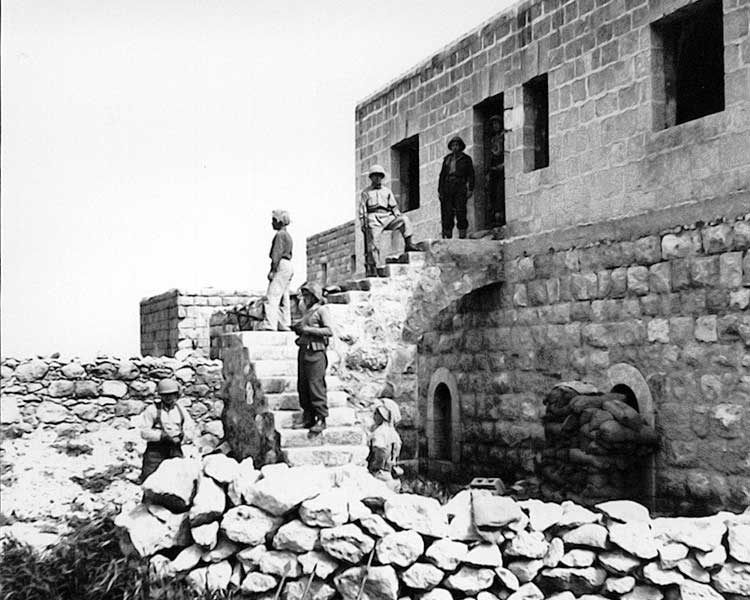
The Road to Jerusalem
During the period between the end the UN vote on partition and the end of the British mandate, Civil War broke out between Jews and Arabs in Palestine. Most of the battles during this period were won by the Jews.
The United Nations' vote to approve the partition plan was met with rejoicing in Jewish Palestine. A dream had been nearly achieved. Golda Meir, the future Prime Minister, spoke to the crowds in front of the Jewish Agency building in Jerusalem, stating:
"For two thousand years, we have waited for our deliverance. Now that it is here, it is so great and wonderful that it surpasses human words. Jews, Mazal Tov!"
However, many understood that the greatest challenge lay ahead. David Shatiel, the commander of the Haganah, understood this well. He wrote in his diary on the night of the 29th, after the partition vote, "None of us knows what might happen tomorrow."
The next day, a Jaffa-based band attacked a bus carrying Jewish passengers. On December 5th, the British cabinet announced they would withdraw all their troops from the country by May 15th, and that, in the interim, they would remain neutral in the fight between Jews and Arabs. By and large, they adhered to this policy, although both sides complained about British actions.
During December, many mixed areas saw population exchanges, and demarcation lines became clear. It is estimated that during this period, 100,000 Arabs either left the country or moved from mixed towns to their ancestral villages.
In early January, members of the Arab Liberation Army, which primarily consisted of Palestinians trained by surrounding Arab states, entered the country without British interference. On January 10, they attacked the settlement of Kfar Szold but were repulsed. Jewish settlements throughout the country were isolated, and major efforts had to be expended to resupply them. Even Jerusalem could only be resupplied at great cost. One of the most famous and tragic situations involved the effort to send reinforcements to the settlements of Kfar Etzion near Jerusalem, which had been cut off from Jewish forces. A platoon of 35 soldiers was sent on foot to reinforce the Etzion settlements. The force was discovered en route and ambushed; all 35 soldiers were killed. This force became known as the 'Lamed Hei' (35 in Hebrew).
By March, the tide of battle seemed to be turning against the Jews. The road to Jerusalem had become impassable. During this period, Jewish forces primarily maintained a defensive posture, only undertaking offensive operations on a local basis.
As a result of these military setbacks, the United States began to waver in its support of the partition plan. The US UN Ambassador, seemingly acting without President Truman's approval, called for a delay in the partition plan and instead proposed placing Palestine under UN trusteeship.
With the situation deteriorating, Ben Gurion demanded that the army move to the offensive to open the road to Jerusalem. This became possible thanks to the successful smuggling of large quantities of small arms into the country. For the first time, troops did not have to share rifles and machine guns.
The first major offensive, called Operation Nachshon, aimed to capture a corridor along the road to Jerusalem and thus secure this route. The major effort along the road was the fight for Kastel, which the Haganah won after a fierce battle on April 10. During the battle, Abd al-Qadir Husayni, the Mufti's military leader, was killed. This effectively ended the involvement of the Mufti's forces in the war. However, the capture of Kastel was only one of the objectives. The goals were to capture all the Arab villages that had been used as bases for fighters who attacked convoys to Jerusalem. One of the villages was Deir Yassin, on the outskirts of Jerusalem. The Irgun, the militia under the command of Menachem Begin, was responsible for attacking it. The attack, which took place on April 9, met stiff opposition and eventually involved house-to-house fighting. This fighting included indiscriminate attacks on houses inhabited by women and children. The result was the death of 100-120 villagers, a number that was quickly exaggerated. However, the impact of Deir Yassin was much greater than the conquest of one village or the death of 120 people, with at least half being combatants. As stories of the day spread, they became more and more lurid, resulting in widespread panic among Arab villagers and prompting more of them to flee.
An immediate consequence of the attack was a revenge attack on a convoy of Jewish doctors and nurses heading to Hadassah Hospital on Mount Scopus. The convoys had usually benefited from a British escort, but on April 13, no British escort showed up. The convoy set off without one, and as it moved forward, a mine went off, blocking their advance. Some vehicles were able to return to West Jerusalem, but two armored buses and two escort vehicles were trapped. The force was able to fend off the attackers for five hours
In the North, the Arab Liberation Army, led by Fawzi al-Kawukji, began a concentrated assault on Mishmar Ha'emeq but was defeated. The forces were then forced to withdraw to Jenin. This defeat destroyed the morale of the Arab villages in the area, and soon they were all fleeing.
In mid-April, the Haganah launched Operation Yiftach, with the goal of liberating the Upper Galilee. On April 18, the Palmach captured Tiberias. On April 21, as the British withdrew from the city of Haifa proper, concentrating their remaining forces in the port area, a brief battle for the city ensued and was quickly won by the Haganah. By May 10, the Arab parts of Safed were captured, and by May 16, Akko was captured. On May 13, Jaffa was captured.
On the Jerusalem front, the Palmach successfully seized most of the major British installations in Jerusalem. However, on May 14, the Etzion bloc fell to the attackers from the Arab Legion.
The period leading up to independence was one of successful consolidation. All of the areas allotted to the Jewish State in the Galilee were firmly under Jewish control, as well as some areas that were to have been part of the Arab State. The coastal plain was secure, as was Jewish Jerusalem. The major areas of concern remained the road to Jerusalem and the many isolated settlements in the south.