The Trail of Tears
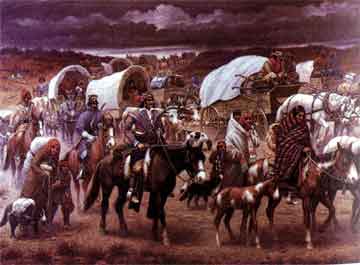
The Trail of Tears was the forced removal of the Cherokee Nation from its homeland in the southern Appalachians to lands west of the Mississippi, the bitter culmination of the Indian Removal Act of 1830. The Cherokee had done everything the United States claimed to want of Native peoples—adopting a written constitution, a syllabary and newspaper, farms and schools—and they fought removal in the courts, winning a Supreme Court decision in Worcester v. Georgia (1832) that affirmed their sovereignty. President Andrew Jackson simply refused to enforce it.
In 1838, federal troops rounded up some sixteen thousand Cherokee at bayonet point, herded them into stockades, and drove them westward over hundreds of miles in the dead of winter. Disease, exposure, hunger, and exhaustion killed an estimated four thousand people along the way—roughly a quarter of the nation. The Cherokee called it 'the place where they cried.' Their ordeal was part of the broader removal of the Five Civilized Tribes—Cherokee, Creek, Choctaw, Chickasaw, and Seminole—from the Southeast, one of the most shameful episodes in American history.