Reagan and Gorbachev Meet in Washington
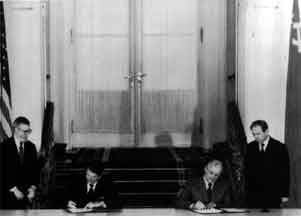
Throughout the Cold War, the United States and the Soviet Union engaged in a dangerous arms race, each seeking to develop and deploy more advanced and powerful nuclear weapons. The development of intermediate-range ballistic and cruise missiles by both superpowers in the 1970s and 1980s raised concerns about the increasing risk of a nuclear conflict in Europe. In response, both countries began exploring ways to reduce tensions and curb the proliferation of these weapons.
The INF Treaty: The INF Treaty, signed by Soviet leader Mikhail Gorbachev and U.S. President Ronald Reagan on December 8, 1987, represented a significant breakthrough in arms control. The treaty required both countries to eliminate all land-based ballistic and cruise missiles with ranges between 500 and 5,500 kilometers (approximately 310 to 3,420 miles), as well as their associated launchers and support structures.
Under the terms of the treaty, both the United States and the Soviet Union agreed to destroy their existing stockpiles of intermediate-range missiles and refrain from producing, testing, or deploying any such missiles in the future. This marked the first time in history that an entire class of nuclear weapons was eliminated through a bilateral agreement. The treaty also established a comprehensive verification regime, which included on-site inspections and continuous monitoring, to ensure compliance by both parties.
Significance of the Gorbachev-Reagan Summit and the INF Treaty: The Gorbachev-Reagan summit and the INF Treaty marked a turning point in the Cold War, as both leaders demonstrated a genuine commitment to reducing the nuclear threat and improving relations between their respective countries. The treaty eased tensions in Europe, which had been a major theater of the arms race, and provided a foundation for further arms control negotiations.
The summit also marked the beginning of a new era in U.S.-Soviet relations, as Gorbachev and Reagan moved away from the confrontational rhetoric of the past and engaged in constructive dialogue. This shift laid the groundwork for future cooperation between the two superpowers, culminating in the signing of the Strategic Arms Reduction Treaty (START) in 1991 and the eventual end of the Cold War.
The INF Treaty proved to be highly successful in achieving its stated goals. By the treaty's deadline in June 1991, the United States and the Soviet Union had destroyed a combined total of 2,692 intermediate-range missiles, effectively eliminating this class of nuclear wweapons.