Understanding Military Protective Orders
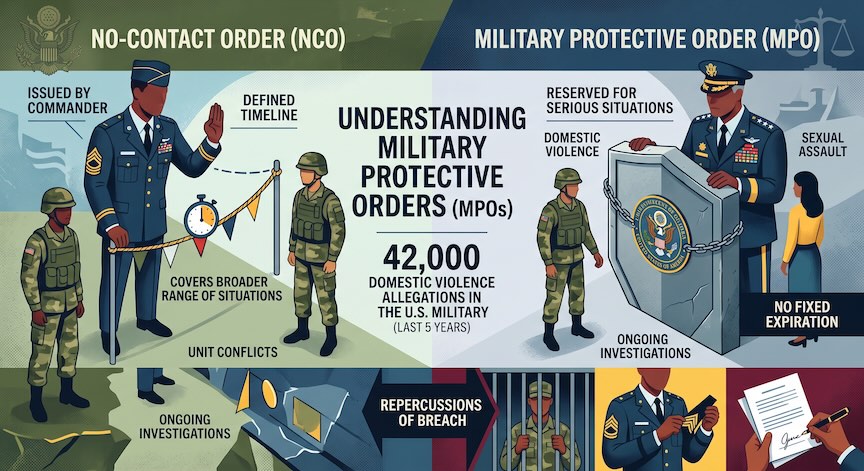
Data recently provided by the Department of Defense reports a figure of almost 42,000 allegations of domestic violence in the U.S. military over the last five years. The statistics provide clear reasons why both the military and civil authorities take domestic violence and protective orders seriously.
In family violence and domestic abuse cases, courts might implement various options, including issuing protective orders to restrict an offender's contact with a victim. But what's the difference between a no-contact order and a military protective order? A no-contact order (NCO) is issued by a commander to a subordinate for a defined timeline and covers a broader range of situations, including unit conflicts or ongoing investigations, while an MPO has no fixed expiration and is reserved for more serious situations such as domestic violence or sexual assault.
It is important for anyone involved in a case of a militarily relevant protective order to comprehend how MPOs function, how they are different from civil orders, and what the possible repercussions are in case of their breach.
Whether you are already under an MPO's constraints or are concerned about the threat of one, familiarizing yourself with your duties and rights can help you make decisions about suitable remedial actions and avoid facing extra liabilities.
What a Military Protective Order Is
A Military Protective Order (MPO) is a written order issued by an active-duty service member's commanding officer. It is not issued by a court. It is a command-level tool, created and enforced entirely within the military chain of command.
Under 32 CFR § 635.19, an MPO may prohibit contact with the protected person, require a service member to leave shared housing, restrict access to certain locations, and impose other safety conditions deemed necessary by the command.
There is no cost to obtain an MPO, and no court hearing is required. The protected person does not appear before a judge, testify, or share a room with the subject during the process.
If you receive an MPO, you still need a lawyer to protect your rights. According to Fort Campbell military defense lawyer Michael J. Thompson, military lawyers can supervise administrative proceedings and engage in certain actions, like submitting documentation and representing their clients in court hearings.
Who Can Request One and How
A person does not have to be a service member to request an MPO. Anyone who has experienced domestic abuse or child abuse involving an active-duty service member can initiate the process.
Eligible people who can request an MPO include current and former spouses, current and former intimate partners who have shared a home, and individuals in a romantic or intimate relationship with the service member. The service member's commanding officer can also initiate an MPO independently.
The quickest route to making an MPO request would be through the Family Advocacy Program (FAP). The victim advocates in FAP could appeal to the commanding officer on behalf of the victim.
Other people who can make the request include installation law enforcement, a FAP clinician, or the victim themselves through direct contact with the unit's legal office. The DoD Domestic Abuse Victim Advocate Locator on Military OneSource can help identify the nearest FAP office.
What MPOs Cover and Their Key Limitations
MPOs can accomplish a great deal. They can remove the abuser from shared housing quickly, without the waiting periods associated with civil court processes. They create a documented record within the military system.
Violations are handled through the military disciplinary structure, including potential consequences under the Uniform Code of Military Justice. This approach can be faster and more responsive than civilian enforcement in some situations.
What that UCMJ enforcement actually looks like depends on the broader military justice process.
Geographic Enforcement
An MPO is enforceable on the military installation where it was issued. The MPO alone does not give civilian law enforcement clear authority to act in the surrounding community, at civilian locations, or in other states away from the military installation.
If the protected person needs protection off-base, a civil protective order from a civilian court is the complementary tool that covers those areas. Both orders can be obtained simultaneously and serve different enforcement environments.
Transfer of the Service Member
When the service member is transferred to a new command, the issuing commander is required to notify the new command of the MPO and recommend its continuation. Keep in mind that this continuation is not automatic. How the MPO is enforced after the transfer depends on the new command's review.
A person with an active MPO whose service member is transferred should contact the original commander or their victim advocate immediately so that the order follows the service member to the new duty station.
Confidentiality Considerations
Reporting through the FAP is not necessarily confidential in all circumstances. Restricted reporting allows a victim to access support and services without triggering a command or law enforcement investigation.
Unrestricted reporting leads to investigation by the command and military criminal investigative organizations. The distinction matters. Some victims fear that an unrestricted report will affect the service member's career and influence the family's financial stability.
Civil Protective Orders: The Complementary Tool
An MPO and a civil protective order (CPO) issued by a civilian court work in parallel. They do not replace each other. A CPO is enforceable by civilian law enforcement everywhere the service member goes.
A CPO does not depend on the military chain of command for enforcement. A person with both an MPO and a CPO protects two overlapping systems: military discipline for on-base violations and civilian law enforcement for off-base violations.
Obtaining a CPO requires going through a civilian court process, which varies by state. WomensLaw.org provides state-specific guides for domestic violence legal protections, including how to obtain a CPO in any state alongside an existing MPO.
Resources and Next Steps
For anyone in the military community who needs immediate safety planning:
- Family Advocacy Program: accessed either through an installation or through the DoD Domestic Abuse Victim Advocate Locator at Military OneSource. For more information, visit militaryonesource.mil
- The National Domestic Violence Hotline: call 1-800-799-7233 (open 24 hours a day, 7 days a week). This hotline can provide military-specific resources and advocates ready to assist.
- Legal Assistance Office: available at military installations, providing free legal guidance including advice on both MPOs and civil protective orders.
- Military OneSource: call 1-800-342-9647 for assistance. This resource provides free, confidential counseling and referral services to help current service members, veterans, and their respective families cope with stress and other life issues.
An MPO is a tool that works within its scope. An MPO is an effective tool when you use it in the right context. In a scenario where a superior officer is responsive, it can be helpful rather easily. The most effective use of an MPO is when its powers and reach are understood and it is supplemented by civilian legal protections.