What Happens if a Drunk Driver Hits You?
What a victim should do in the moments after an impaired-driver crash — and how the criminal case, civil claim, and insurance fight all unfold on separate tracks.
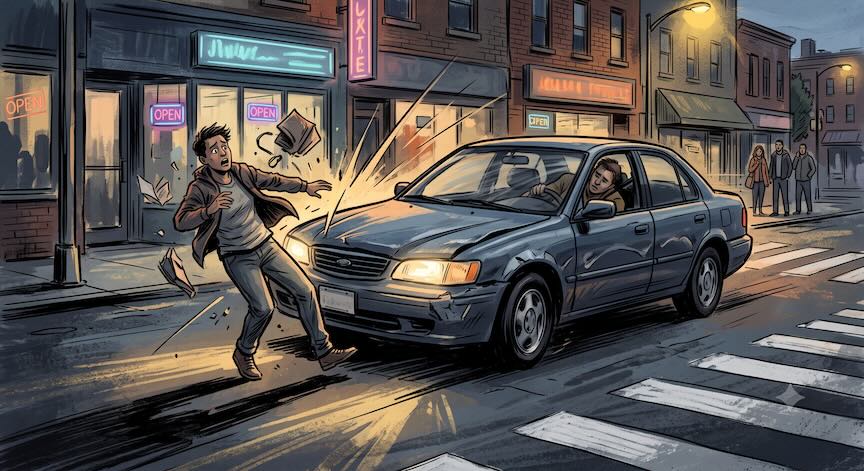
Alcohol-impaired motorists remain a huge threat to public safety, as it is the leading cause of road accidents in the US. Reports from NHTSA indicate that in 2024, the total number of deaths caused by drunk driving accidents reached 11,904 people. These incidents accounted for about three out of ten deaths from road accidents on a national scale.
As a result of a drunk driving crash, one life is lost every 44 minutes. This horrifying statistic demonstrates the hazards of drinking before proceeding to operate a vehicle. A crash that involves a drunk driver can bring several changes to one’s life in an instant. Victims commonly end up dealing with swelling medical expenses, loss of earning ability, major vehicle destruction, and increase in insurance premiums.
Car accidents caused by drunk driving may also result in the criminal prosecution of the drunk driver. At the same time, victims of the incident can initiate a civil suit for damages.
So, “if a drunk driver hits you, will you be protected?” The answer to this question will depend on the actions you take immediately after the incident.
Let’s find out what steps drunk driving accident victims should undertake to protect their rights and interests.
What to Do at the Scene and Immediately After
Contact 911. When the police arrive at the scene, they will normally conduct a field sobriety test. They will conduct a breathalyzer or blood test on the suspect if necessary. When an individual is arrested or convicted for a DUI offense, he/she is said to have committed negligence per se according to most states' laws.
Before you leave, gather as many details as possible. Get photographs taken of where the vehicles were parked, the state of the road, any visible injuries, and damages to both vehicles.
Gather the witnesses’ names and contact information. If the driver says they drank, write down what they said as soon as you can. Give that written note to your attorney. Don’t negotiate with the driver. Don’t go back and forth about fault or who caused what.
Have your body checked up that day, regardless of how minor you think your injuries are. Problems within the soft tissue, inner body injuries, and traumatic brain injury usually have symptoms that manifest themselves later on. Failing to go for a medical checkup can lead to Insurance companies arguing that the injuries were not from the crash.
How the Criminal Case Affects Your Civil Claim
Most people don’t realize that the whole criminal prosecution of the drunk driver and your personal injury claim are independent proceedings. The state runs the criminal case, while the victim handles the personal injury claim. Both matters follow different legal standards along with different deadlines.
The prosecutor in a DUI case must show there is no reasonable doubt you were liable for the incident. In a civil trial, it is enough to prove that the driver's negligent action existed and that it directly caused your injuries. Since both cases are independent of each other, being acquitted in a criminal case does not automatically mean you are not guilty of the civil charges you are facing.
A criminal conviction boosts your civil claim. Courts in most jurisdictions allow civil plaintiffs to bring in a criminal conviction as evidence of fault.
Third-Party Liability: The Bar or Restaurant May Also Be Responsible
For a drunk driving accident court case, it is critical to address liability first. According to New Orleans drunk driving accident lawyer Joshua L. Rubenstein, a plaintiff must prove not only the drunk driver's fault but also that this fault caused the injuries they sustained.
Aside from the at-fault driver, liability can also extend to other parties. Even liquor shops can face liability under dram shop laws. According to the latest statistics, around 43 states observe the dram shop law. Under this law, the place that sold alcohol can be sued in civil court if it continues to sell alcohol to someone who is visibly drunk and that person later causes an accident. In the dram shop case, the evidence will consist of the bar video and the receipt showing how much the customer purchased.
Social host liability carries the same logic over to private gatherings. If a party host served alcohol to the drunk driver, some states let injured victims file claims against the host.
Trying to pursue dram shop or social host liability is usually not straightforward. Bars and restaurants rarely just hand over records, and the staff doesn’t admit that a patron showed obvious signs of intoxication.
A drunk driving accident attorney can issue subpoenas for records, speak with witnesses, and coordinate with investigators so the evidentiary foundation that these claims demand gets put in place properly.
Damages You Can Recover
The economic damages include the financial impacts that the crash caused. The economic damages include the medical bills that have already been incurred, future treatment bills that are likely to be incurred, loss of wages resulting from being incapacitated, an inability to earn in the future if injuries affect your work, car damage, and other minor losses.
The non-economic damages cover the intangible aspects of the incident. Recovery claims may be made for pain and suffering, emotional turmoil, and loss of quality of life. Non-economic damages also cover a spouse’s loss of consortium. These are usually measured by the courts based on several considerations.
Punitive damages are available in most states when the driver’s actions hit the legal threshold of recklessness or a conscious disregard for other people’s safety. Drunk driving often meets the requirements for punitive sentencing.
Compared with compensatory damages, punitive damages are meant to punish the defendant and also to discourage similar behavior later.
Dealing With the Insurance Company
The drunk driver’s liability insurer will usually put an adjuster on your claim. The adjuster’s role is to get it settled for as little as possible.
You should report the accident to your insurer right away. Your report must be clear and concise. Give the police report number, say that the other driver was cited for DUI, and list every medical treatment you got, including dates and providers if you can.
If that drunk driver turns out to be underinsured or uninsured, then your own uninsured (UM) and underinsured motorist (UIM) coverage covers the expenses. Many people who are badly hurt in drunk driving crashes immediately reach the at-fault driver’s policy limits. If this particular situation happens, you can try to recover the rest through UM or UIM coverage.
The First Steps Determine the Outcome
Drunk driving injury cases go in a different legal process than regular car accident claims. The driver’s illegal conduct opens the possibility of punitive damages and makes it easier to prove negligence.
Better results can be expected when a case is documented carefully, every available insurance and third-party coverage is accounted for, and a realistic projection of future losses is already mapped out.
The NHTSA impaired driving resources and the specific DUI laws in each state set up the legal basis for how a case proceeds. This foundation gets built depending on what evidence gets gathered and what legal approach is chosen right from day one.