America's Secret Cold War Facilities That Still Operate Today
During the Cold War, the United States government built a network of hidden facilities designed to ensure the survival of the American state in the event of nuclear war. While the threat of Soviet missiles has faded, many of these installations remain active — repurposed, modernized, and still classified. Three of the most significant are still operational today, each playing a distinct role in the architecture of national security.
Camp Peary: The CIA's Hidden Training Ground
Tucked away in the forests of York County, Virginia, Camp Peary is one of the most secretive installations in the United States. Known informally as "The Farm," it has served as the CIA's primary covert training facility since the 1950s.
The site has a darker origin. Before the CIA arrived, the land was home to Magruder, a community of predominantly African American families who had farmed the area since Reconstruction. In 1942, the U.S. Navy seized the land to build a Seabee construction training base, displacing hundreds of residents with minimal compensation. After the war, the CIA quietly took over the property.
Today, Camp Peary is believed to function as a training ground for clandestine operatives, where recruits learn surveillance, paramilitary tactics, and covert communication. The U.S. government has never officially confirmed the facility's purpose. It does not appear on standard maps, and the perimeter is secured by razor wire and armed guards. Family cemeteries from the Magruder community remain inside the restricted zone, accessible to descendants only through a tightly controlled permission process.
Cheyenne Mountain: The Underground Fortress
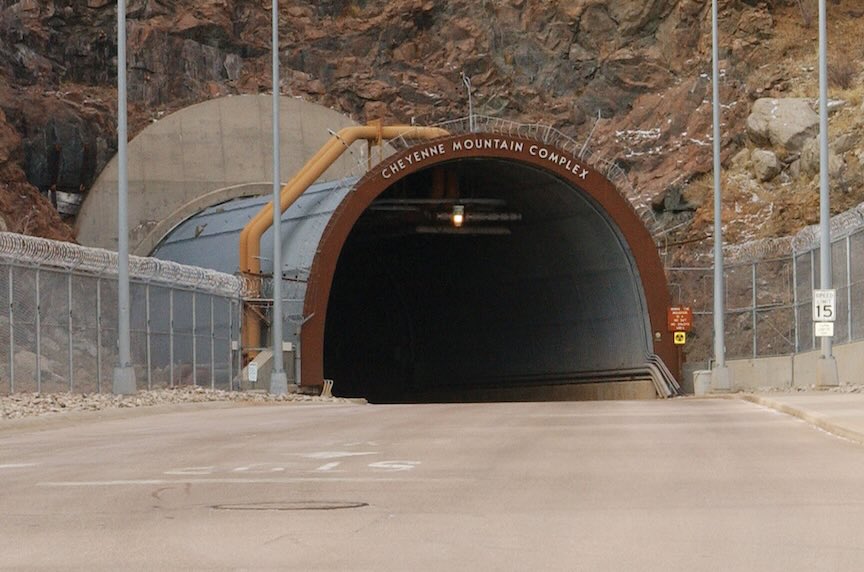
Buried beneath 2,000 feet of granite in the Colorado Rockies, Cheyenne Mountain Complex was built in the early 1960s as the command center for the North American Aerospace Defense Command (NORAD). Its mission was straightforward: detect a Soviet nuclear launch and coordinate the American response before the missiles arrived.
The engineering behind the facility was extraordinary. The complex consists of 15 buildings mounted on massive steel springs, designed to absorb the shockwave of a nearby nuclear detonation. Every structure functions as a Faraday cage, shielding electronics from the electromagnetic pulse that would accompany a nuclear blast. The facility can seal itself off from the outside world with 25-ton blast doors and operate independently on its own power, water, and air filtration systems.
In 2006, NORAD relocated its day-to-day operations to nearby Peterson Air Force Base, but Cheyenne Mountain was never shut down. It currently operates on "warm standby" — fully staffed and maintained around the clock. The rise of hypersonic missile threats from Russia and China has renewed the mountain's strategic importance. Unlike digital command centers on the surface, a mountain cannot be hacked.
Raven Rock: The Underground Pentagon
Located beneath the Appalachian hills along the Pennsylvania-Maryland border, Raven Rock Mountain Complex — also known as "Site R" — was built in the early 1950s as an alternate command center for the Department of Defense. If Washington, D.C. were destroyed in a nuclear attack, the Pentagon's leadership would relocate here to maintain command of the U.S. military.
The facility was constructed by tunneling into the greenstone rock of the mountain, creating a self-contained underground city. It contains multiple three-story buildings, its own power plant, reservoirs of drinking water, and enough supplies to sustain thousands of personnel for extended periods. During the Cold War, it was connected to the White House and the Pentagon through dedicated communication lines.
Raven Rock became publicly visible on September 11, 2001, when Vice President Dick Cheney and other senior officials were evacuated there following the attacks. It was one of the few moments in the facility's history when its existence was openly acknowledged in real-time. Today, Raven Rock continues to serve as the military's primary backup command center, modernized to address 21st-century threats but rooted in the same Cold War logic: the government must survive, even if the capital does not.
A Hidden Network
Camp Peary, Cheyenne Mountain, and Raven Rock represent three pillars of the American continuity-of-government program — intelligence, detection, and command. Built during the most dangerous decades of the nuclear age, all three remain active, reminding us that the infrastructure of the Cold War did not disappear when the Berlin Wall fell. It was simply reclassified.
For more in-depth stories on places like these — from Cold War bunkers and secret military bases to abandoned cities and forgotten prisons — visit The Dark Atlas.