How Optical Character Recognition Changed Historical Research
From microfilm readers to searchable newspapers — how OCR turned scanned pages into text historians can search, and why the original documents still matter
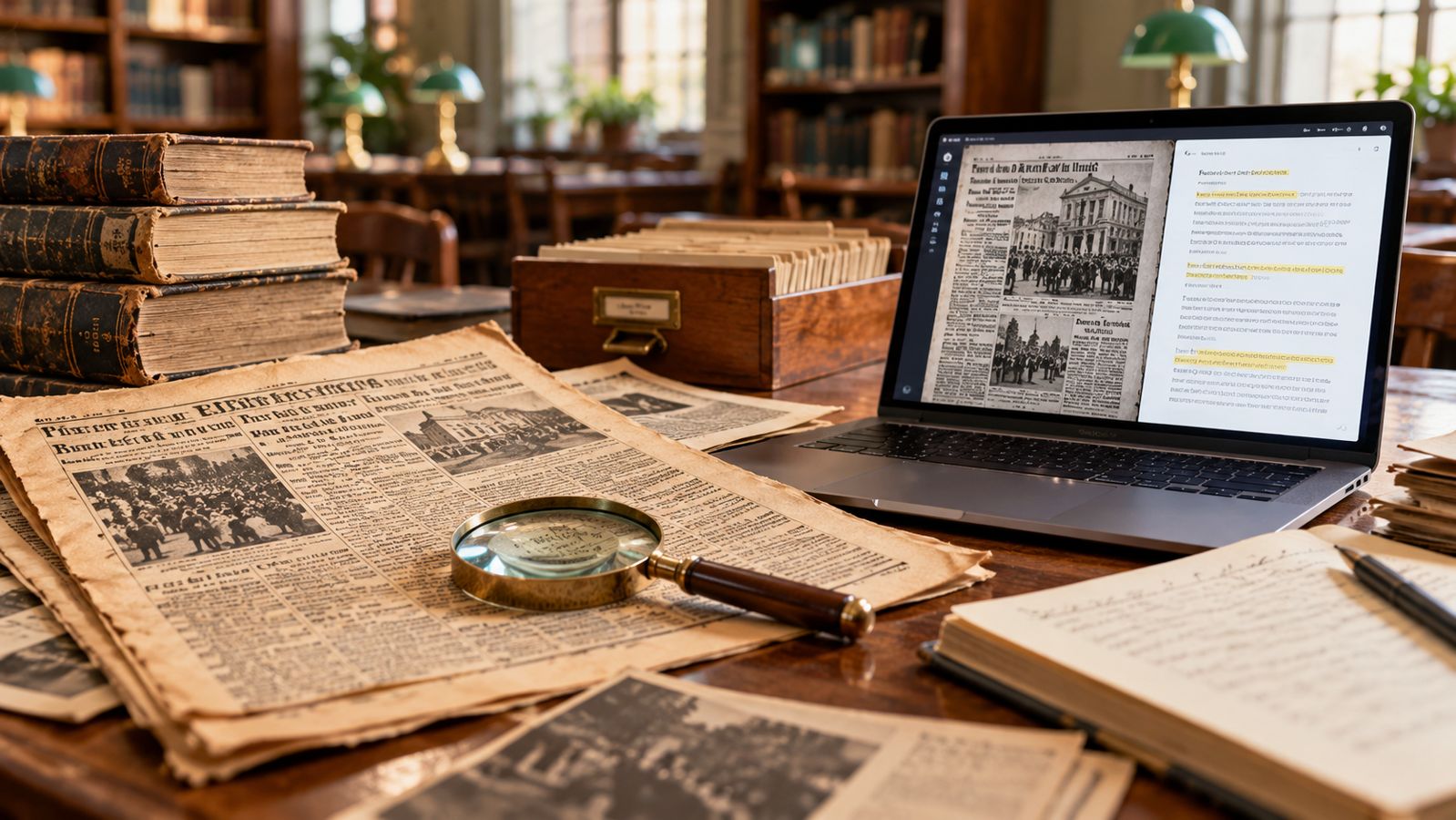
For much of modern history, researchers depended on physical archives, handwritten indexes, and countless hours of reading to locate information hidden in old documents. Finding a particular name in a century-old newspaper could mean examining hundreds of pages, often with no guarantee of success. The development of optical character recognition changed that process. Today, historians can extract text from scanned documents using OCR technology, turning previously inaccessible printed material into searchable digital information. This capability has reshaped how scholars investigate historical events, trace family histories, and study changes in language and society. More importantly, it has made historical records accessible to people who may never have the opportunity to visit the institutions preserving the original documents.
Historical Research Before Digital Archives
Before computers became part of everyday research, historians relied on library catalogs, printed bibliographies, archival inventories, and physical collections. A researcher studying a local election in the nineteenth century might need to visit several libraries, request bound newspaper volumes, and examine individual issues.
Microfilm eventually made many collections easier to preserve and consult. Libraries could store photographic reproductions of newspapers and official records without requiring constant handling of fragile originals.
However, microfilm did not solve the problem of finding specific information. Researchers still had to scroll through images and read the material manually.
The process was especially difficult when the approximate date or location of an event was unknown. A single investigation could involve numerous visits to archives, extensive note-taking, and considerable time spent searching for references that might not exist.
The Early Development of Optical Character Recognition
The origins of automatic character recognition reach back to early experiments with optical reading devices. By the middle of the twentieth century, practical OCR systems were beginning to emerge as computers became increasingly important in business and administration.
Early machines were designed for relatively controlled tasks, such as interpreting printed characters on forms, processing numerical information, or reading standardized documents. Their capabilities were limited, and the equipment was expensive.
During the 1960s and 1970s, advances in electronics and pattern recognition expanded what these systems could process. Researchers developed techniques for identifying different typefaces and handling increasingly complex printed material.
The growing availability of personal computers and scanning equipment later brought OCR into a wider range of workplaces. Libraries and research institutions could begin considering automatic text recognition as part of large-scale document digitization.
Why Scanning Alone Was Not Enough
Scanning represented a major improvement in historical preservation. A digital image could reproduce a fragile newspaper, letter, or printed document without requiring researchers to handle the original.
Yet an image contains pixels rather than searchable words. A computer cannot automatically find every occurrence of a person’s name inside an ordinary photograph of a newspaper page.
OCR provides the missing connection. It examines the visual shapes of characters and converts recognizable text into machine-readable information.
For example, a scanned newspaper might contain hundreds of articles discussing economic conditions in a particular city. Once the text has been recognized, researchers can search for terms such as unemployment, factory closure, or railway construction.
The original page image remains valuable because it preserves the appearance and context of the source. OCR adds another layer of accessibility without replacing the historical document itself.
How Searchable Newspapers Transformed Historical Research
Newspapers are among the most useful sources for investigating everyday life. They document local businesses, public debates, political campaigns, cultural events, and developments that may receive little attention in traditional history books.
The Library of Congress demonstrates the value of OCR through its Chronicling America collection, which provides access to digitized historical newspapers. Researchers can search newspaper text and examine the corresponding page images.
This creates opportunities that would have been difficult with physical collections alone.
Someone investigating a nineteenth-century labor dispute can search for a factory name across multiple newspaper issues. A family historian can look for references to an ancestor in advertisements, notices, or local reporting.
Search results are not always complete or accurate, but OCR dramatically changes the starting point. Instead of reading every available page, researchers can identify promising sources and investigate them more closely.
Discovering Historical Patterns Through Large Collections
OCR has also changed the kinds of questions historians can investigate. Once documents become machine-readable, researchers can examine patterns across collections that would be impractical to read individually.
For example, a study of public attitudes toward industrialization might examine how frequently certain terms appeared in newspapers over several decades. Researchers could compare references to factories, machinery, wages, and working conditions.
Similar approaches can help explore changing political language, public health discussions, or the vocabulary used to describe immigration.
However, the frequency of a word does not automatically reveal what people believed. Historical terminology changes, newspapers reflect editorial decisions, and surviving collections rarely represent every community equally.
OCR makes large-scale analysis possible, but interpretation still depends on historical knowledge. The technology helps identify patterns and potential connections; researchers must determine what those findings actually mean.
The Challenges of Recognizing Historical Documents
Historical sources present difficulties that ordinary printed documents often do not. Paper may be damaged, ink may have faded, and older typefaces can confuse character recognition systems.
Newspaper layouts introduce additional complications. Multiple columns, narrow spacing, illustrations, and advertisements can interfere with the correct reading order.
Common problems include:
- Confusing similar-looking letters and numbers.
- Combining words that originally appeared on separate lines.
- Misreading faded, damaged, or heavily ornamented text.
- Losing the correct sequence of multi-column articles.
- Producing inaccurate names, dates, or numerical values.
These errors matter because historians frequently depend on small details. A misrecognized surname can hide an important record, while an incorrect date can distort an event’s chronology.
Handwritten documents are particularly challenging and may require specialized handwriting recognition systems or manual transcription rather than conventional OCR.
Verifying OCR Results Against Original Sources
OCR output should be treated as a research aid, not an authoritative transcription. A useful search result is often the beginning of an investigation rather than its conclusion.
Suppose a researcher finds a newspaper reference to a particular court case. Before quoting it, the researcher should inspect the original page image and confirm that the recognized text matches the printed source.
This is particularly important when working with names, historical quotations, financial figures, and dates.
A practical verification process involves locating the relevant document, comparing the recognized text with the image, correcting transcription errors, and recording the source’s identifying details.
Researchers should also preserve information about where the document came from. Publication dates, page numbers, archival identifiers, and collection names help others evaluate the evidence.
Digital convenience does not remove the need for traditional source criticism.
The Role of Modern PDF Tools in Document Research
OCR is no longer limited to major libraries and research institutions. Individuals working with family records, local history collections, and scanned administrative documents can now use digital tools to recognize and organize text.
For example, pdfFiller supports OCR conversion of scanned files into editable text. It also provides capabilities for editing PDF content, adding annotations, and rearranging or comparing documents.
These functions can be useful when a researcher needs to examine several versions of a document or annotate an archival copy for a research project.
However, historical preservation requires careful handling of source material. Researchers should retain an unchanged copy of the original scan and perform edits on a separate working document.
For records containing personal or confidential information, access controls and appropriate document-handling practices also matter.
The technology simplifies document preparation, but decisions about authenticity and interpretation remain with the researcher.
Making Historical Records More Accessible
One of OCR’s most important contributions is the expansion of access to historical information.
Students can investigate local history without traveling to distant archives. Genealogists can search digitized newspapers for family names. Independent researchers can explore historical debates using materials that were once available primarily to specialists.
Searchable text can also support accessibility tools that help people interact with documents in different ways. Nevertheless, recognition quality, reading order, and document structure still affect how accessible the resulting files actually are.
The most effective digital archives combine searchable text with high-quality images, reliable descriptions, and clear information about the original sources.
As recognition systems continue to improve, more historical material may become easier to discover and study. The challenge is ensuring that convenience does not obscure uncertainty, transcription errors, or the context in which records were created.
The Future of Historical Document Research
Machine learning has expanded the possibilities of document recognition beyond the relatively rigid character-matching approaches used by earlier systems.
Modern methods can assist with complex layouts, varied typography, and some forms of historical handwriting. Researchers may also combine recognized text with computational tools to identify recurring names, locations, and subjects across large collections.
These capabilities create new possibilities for comparing sources, discovering overlooked connections, and revisiting familiar historical questions.
Still, automation cannot determine the meaning or reliability of a source on its own. A historical newspaper article may contain prejudice, factual mistakes, or deliberate political messaging, regardless of how accurately its text is recognized.
The greatest contribution of OCR is therefore not replacing historians. It gives them more effective ways to locate evidence, examine wider collections, and spend more time interpreting the historical record.
Frequently Asked Questions
What is OCR, and why is it useful for historical research?
Optical character recognition converts images of printed text into computer-readable characters. For historians, this makes scanned newspapers, books, and archival records searchable. Instead of inspecting every page manually, researchers can locate names, dates, and subjects more efficiently while still checking the original documents for accuracy.
Can OCR accurately read old newspapers?
OCR can recognize substantial amounts of text in historical newspapers, but its accuracy depends on image quality, typography, page layout, and document condition. Faded print, damaged pages, and narrow columns often create errors. Researchers should verify important quotations, names, and dates against the original scanned images.
Can OCR recognize handwritten historical documents?
Conventional OCR is primarily designed for printed text. Handwritten materials often require specialized handwriting text recognition methods. Results vary depending on writing style, ink quality, language, and document condition. Particularly difficult manuscripts may still need manual transcription or correction by someone familiar with the historical handwriting.
Does converting a scanned PDF with OCR change the original document?
OCR can add machine-readable text to a scanned document or produce an editable version, depending on the workflow. Historical researchers should preserve the original scanned file separately. This makes it possible to check recognized text against the source and maintain a reliable visual record of the document.
How can historians avoid mistakes when using OCR-generated text?
Researchers should compare important passages with the original images, check unfamiliar names and dates, and consider alternative spellings when searching. It also helps to record publication details and archive identifiers. OCR is most reliable when used as a discovery tool alongside careful source verification and historical interpretation.