How U.S. Police Body Armor Evolved After the First 1972 NIJ Standard
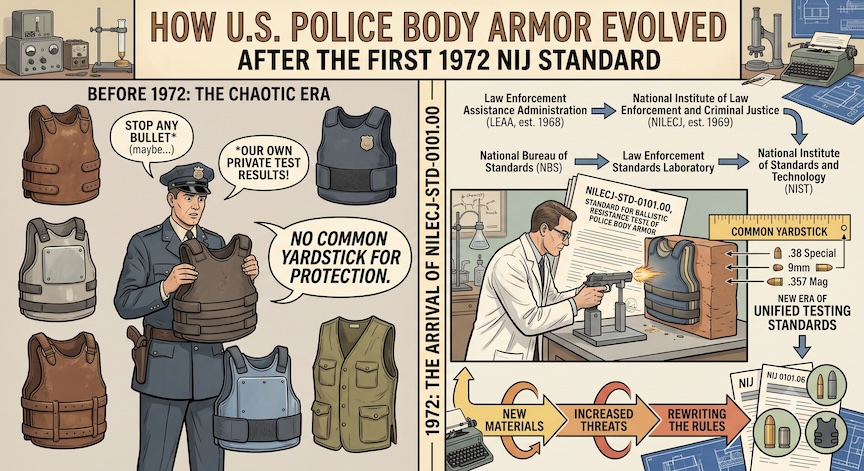
Before 1972, an American police officer buying a protective vest had no common yardstick for what it would actually stop. Protection was whatever the manufacturer claimed, tested however the manufacturer chose. The document that changed this was not a new vest or a new fiber. It was a federal performance standard, and its history is the history of an institution rewriting its own rules, repeatedly, as materials and threats outran the last edition.
A standard, a laboratory, and a chemist's hunch
The standard arrived through the machinery the federal government had just built for exactly this kind of work. The Law Enforcement Assistance Administration, created in 1968, spun up a research arm called the National Institute of Law Enforcement and Criminal Justice (NILECJ), the direct predecessor of today's National Institute of Justice. To handle the technical side, the government leaned on the Law Enforcement Standards Laboratory at the National Bureau of Standards, the agency now known as the National Institute of Standards and Technology.
In March 1972, that partnership published NILECJ Standard 0101.00, "The Ballistic Resistance of Police Body Armor." It was a voluntary national standard: minimum performance requirements and repeatable test methods that any manufacturer could certify against and any department could cite in a purchase order. For the first time, "bulletproof" had a definition a buyer could hold a product to.
The timing was not an accident. DuPont's Kevlar, the aramid fiber Stephanie Kwolek had discovered in 1965 while working on tire reinforcement, had made lightweight concealable soft armor plausible for the first time. The person usually credited with connecting the fiber to policing is NIJ chemist Lester Shubin, who ran the institute's technology assessment program for two decades. Told that Kevlar was stronger than steel and lighter than nylon, Shubin asked whether it could stop a bullet. As he told the story, nobody knew, so they folded some up, shot at it, and watched the rounds bounce off.
Building the whole apparatus
A standard on paper protects no one. What made 1972 durable was that NIJ, working with the U.S. Army, treated the standard as one piece of a larger system it spent the decade assembling.
Army researchers at Edgewood Arsenal had a wearable Kevlar garment, seven layers of fabric, ready for trials by 1973. Field testing began in the summer of 1975, when the institute distributed roughly 5,000 vests to fifteen urban police departments to see how the new armor held up in actual service. The program produced its first documented save that December, when Seattle patrolman Raymond Johnson survived being shot in the chest during a struggle in a market checkout line while wearing one of the test vests.
By 1978 the institute had added the missing enforcement piece: a voluntary compliance testing program, in which manufacturers submitted samples to approved laboratories and compliant models were placed on a public list. These early editions also organized armor into the Roman-numeral types (I, IIA, II, IIIA, III, and IV) that would define the field for the next thirty years, each tier keyed to the calibers and velocities it was required to defeat. The architecture that resulted, a written standard, a testing program, and a compliant products list, is essentially the same structure NIJ uses today.
The 0101.06 era and the failure that forced it
The standard was revised several times over the following decades, but the revision that reshaped the program came out of a single, hard field lesson.
On the night of June 23, 2003, in Forest Hills, Pennsylvania, Officer Edward Limbacher was shot in the abdomen through a Second Chance Ultima vest built primarily from Zylon, a high-strength fiber made by the Japanese firm Toyobo. It was the first case reported to NIJ in which armor certified as compliant apparently failed to stop a round it was rated to defeat. The incident, and mounting concern across the law enforcement community, prompted Attorney General John Ashcroft to announce a Department of Justice Body Armor Safety Initiative in November 2003, directing NIJ to test Zylon-based armor and to audit the certification process itself.
The findings were damaging. NIJ tested 103 used Zylon vests turned in by departments around the country and found that 60 of them, 58 percent, were penetrated by at least one round in a six-shot series. Of the vests that were not penetrated, most showed backface deformation beyond the standard's 44 millimeter limit, the depth of blunt trauma an officer would absorb. Crucially, testers found no reliable relationship between how worn a vest looked and how it actually performed. Zylon, it turned out, degraded with exposure to heat, moisture, and light, and a visual inspection could not reveal it.
The institutional response ran on two tracks. In 2005, NIJ issued interim requirements that effectively barred Zylon-based models unless makers could prove they held up across their warranty period. Then, after roughly five years of research, workshops with manufacturers, and scrutiny of the entire testing regime, NIJ launched Standard 0101.06 in December 2008. The overhaul added a conditioning protocol that mechanically aged armor before ballistic testing, tightened the test methods, adjusted the classification levels, and restructured the compliance program. The lesson embedded in 0101.06 was that certifying new armor was not enough. The standard now had to account for how armor behaves after years on an officer's torso.
The 2023 to 2026 transition to 0101.07
That 2008 framework governed American body armor for fifteen years. Its replacement is being implemented right now, which makes this a rare case of institutional history still in motion.
NIJ published Standard 0101.07 on November 29, 2023, the seventh revision of the 1972 original. Two structural choices stand out. First, the threat definitions and level names were moved out of the armor standard and into a separate companion document, NIJ Standard 0123.00, so the government can update the list of relevant threats without rewriting the entire performance standard each time. Second, the Roman-numeral levels that had organized the field since the 1970s are being retired in favor of plainer designations: HG for handgun-rated soft armor and RF for rifle-rated hard plates.
The genuinely new element is a rifle tier. The old system jumped from Level III, rated for 7.62 millimeter ball, to Level IV, rated for armor-piercing rounds, leaving a gap that manufacturers had filled informally with unofficial "III+" labels. The new standard closes it with RF2, a formally defined intermediate level tested against the 5.56 millimeter M855 round at roughly 3,115 feet per second, a common threat that the previous Level III was never required to stop. The revision also added edge-shot testing and, notably, improved test methods for female body armor, an area the older standard had handled poorly.
The changeover is deliberately gradual. NIJ has committed to maintaining the 0101.06 compliant products list through at least the end of the decade, so agencies are not forced to re-equip overnight while manufacturers certify products to the new benchmark. In practice, that leaves buyers and departments with a translation problem during the transition: matching the levels they have specified for years against the new HG and RF designations. Manufacturers have begun publishing guidance that does exactly this, and a current reference such as the body armor guide maintained by Safe Life Defense lays out how the handgun and rifle classes map onto the protection levels agencies already know.
An institution that keeps rewriting itself
Set the whole sequence side by side and the pattern is consistent. A single voluntary standard in 1972 grew into a layered federal system: a performance standard, a companion threat specification, a testing program, and a public list of certified armor. Each major revision was a response to something the previous version could not anticipate, whether a new fiber, a new rifle threat, or the discovery that a certified vest could quietly lose its protection on the job. The 2023 to 2026 transition to 0101.07 is the latest turn of that cycle rather than the end of it. If the last fifty years are any guide, an eighth revision is not a question of whether, but of what forces it.