From Musket to Repeater: How Small Arms Shaped America's Wars
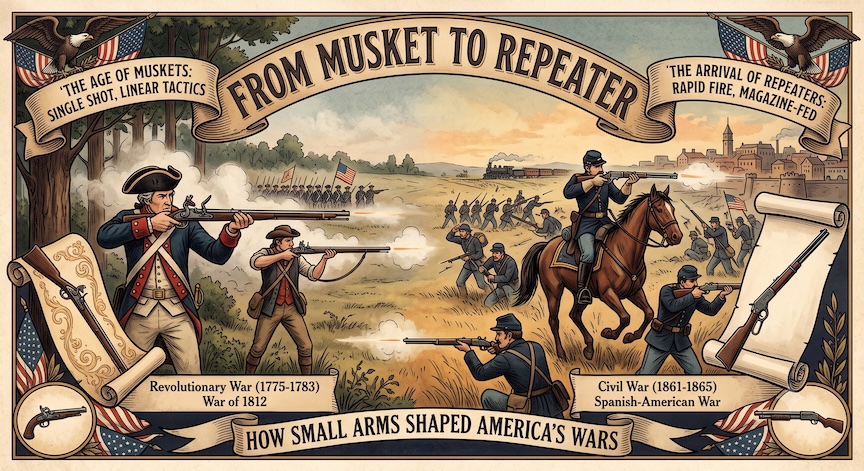
Wars are usually remembered through their generals, their turning-point battles, and their treaties. But underneath the strategy sits something more mundane and, arguably, more decisive: the weapon in the ordinary soldier's hands. Across roughly a century and a half, the evolution of American small arms, from the smoothbore musket to the mass-produced repeating rifle, quietly rewrote how the nation fought, who could fight, and how many did not come home. The technology did not just serve history. In several cases it bent it.
The musket and the limits of the Revolution
The soldiers of the American Revolution carried muzzle-loading, smoothbore muskets, the British Brown Bess and the French Charleville chief among them. These were not precision instruments. A trained infantryman could manage perhaps three or four shots per minute, and beyond about fifty to seventy yards, hitting a specific target was more luck than skill. This is why Revolutionary and Napoleonic tactics look so strange to modern eyes. Men stood shoulder to shoulder in lines and fired in volleys because massed, simultaneous fire was the only way to make an inaccurate weapon effective.
There was an exception, and it mattered. Frontier riflemen carried the long rifle, often called the Pennsylvania or Kentucky rifle, whose grooved barrel spun the ball and gave it far greater accuracy at range. Units such as Daniel Morgan's riflemen used it to devastating effect against British officers at battles like Saratoga. The trade-off was speed. The tight-fitting ball that made the rifle accurate also made it slow to load, which kept it a specialist tool rather than the standard arm. The tension between accuracy and rate of fire would define small-arms development for the next hundred years.
The rifled musket and the tragedy of the Civil War
By the 1860s, that tension had partly resolved, and the result was catastrophic. The widespread adoption of the rifled musket, firing the conical Minié ball, meant that ordinary infantry now carried weapons accurate to several hundred yards. The Springfield Model 1861 and the imported British Enfield put rifle-grade range into the hands of hundreds of thousands of men.
The problem was that tactics had not caught up with technology. Commanders on both sides had been trained in the era of the smoothbore, and they still ordered the close-order frontal assaults that made sense when muskets were inaccurate. Against rifled muskets, those same formations became killing grounds. Much of the appalling casualty count of the Civil War owes to this lag, a generation of officers fighting a new weapon with old doctrine. The federal arsenals that produced these arms in enormous numbers were themselves a story worth telling. The history of Springfield Armory and America's munitions factories runs from a site George Washington personally scouted during the Revolution to the industrial engine that armed the Union.
The repeater and the man who saw it coming
Even as the rifled musket was doing its terrible work, a more radical idea was arriving on the battlefield: the repeating rifle. The Henry rifle, capable of firing sixteen rounds before reloading, gave the handful of Union units that carried it a staggering advantage in volume of fire. Confederate soldiers reportedly described it as the rifle you loaded on Sunday and fired all week.
The Henry's commercial and mechanical descendants would carry the name of a shirt manufacturer turned arms magnate. The story of Oliver Winchester is less about invention than about vision and manufacturing. He recognized that the future belonged to the repeater and built the company that would make it ubiquitous, turning the Winchester into one of the most consequential products of the nineteenth century. The Model 1866 and the Model 1873 that followed did not decide a single great battle the way the rifled musket had shaped the Civil War, but they transformed the American West, frontier conflict, and the country's entire relationship with firearms.
Interchangeable parts and the American system
There is a second thread running through this story that is easy to overlook, and it may be the most important one of all: how these weapons were made. The federal armories, Springfield foremost among them, became laboratories for what came to be called the American system of manufacturing, built around interchangeable parts and standardized production.
This mattered far beyond the battlefield. A rifle assembled from interchangeable components could be repaired in the field by swapping parts rather than commissioning a gunsmith to hand-fit a replacement. But the techniques developed to mass-produce firearms, precision machining, standardized measurement, and the assembly of complex objects from uniform parts, migrated outward into sewing machines, clocks, bicycles, and eventually automobiles. The pursuit of a better military rifle helped seed the industrial revolution that made the United States an economic power. War drove manufacturing, and manufacturing remade the country.
The world wars and the maturation of the American rifle
By the twentieth century, the arc reached its logical end. The bolt-action Springfield M1903 gave American troops a reliable, accurate standard rifle in the First World War. In the Second, the United States fielded the M1 Garand, the first semi-automatic rifle to be standard issue for a major army, giving the individual American infantryman a rate of fire his adversaries could not easily match. General Patton called it the greatest battle implement ever devised, and while that is a soldier's hyperbole, it captured something real: the American emphasis on volume of accurate fire, traceable all the way back to Morgan's riflemen and the Henry repeater, had become national doctrine. Notably, private industry now armed the nation at scale, with commercial manufacturers like Winchester producing the M1 Garand and the M1 Carbine alongside government arsenals.
The weapon as a historical actor
None of this is to reduce American history to hardware. Ideas, leadership, geography, and sheer human will decide these conflicts. But the small arms of each era set the terms on which those forces operated. The smoothbore made the line-and-volley Revolution. The rifled musket made the Civil War far deadlier than its commanders anticipated. The repeater reshaped the West and the arms industry. And the drive to manufacture all of it helped build the industrial nation that would dominate the century to come.
The soldier's weapon is never just a tool. It is a record of what a society could build, how it chose to fight, and how much it was willing to lose. Read that record carefully, and the familiar story of American history looks a little different, and a good deal more mechanical, than the one told through generals and treaties alone.