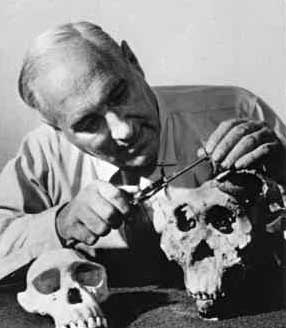
Louis Leakey was the pioneering paleoanthropologist whose discoveries in East Africa revolutionized the study of human origins and helped establish Africa as the cradle of humankind. Born in Kenya to British missionary parents, he was raised among the Kikuyu people, spoke their language, and developed a lifelong attachment to Africa.
Educated at Cambridge, Leakey devoted his life to the search for human ancestors, focusing on Olduvai Gorge in Tanzania, where he and his wife, the equally formidable archaeologist Mary Leakey, conducted decades of patient excavation. Their work uncovered an extraordinary trove of stone tools and fossil remains that pushed the human story far back in time.
In 1959 Mary Leakey discovered the skull of a robust early hominid, "Zinjanthropus," a find that brought the couple worldwide fame and a flow of research funding. Subsequent discoveries, including Homo habilis — "handy man," an early tool-making human ancestor — transformed scientific understanding of human evolution and confirmed that humanity's origins lay in Africa, not Asia or Europe.
A charismatic and sometimes controversial figure, Leakey was also a gifted promoter of science who inspired a generation of researchers. Among his lasting legacies was his support for three young women — Jane Goodall, Dian Fossey, and Biruté Galdikas — whom he sent to study chimpanzees, gorillas, and orangutans in the wild. He died in 1972, founder of a scientific dynasty.