American President John F. Kennedy was born in Brookline, Massachusetts. From 1936-1940, Kennedy attended Harvard, where he wrote a senior thesis that later was published and earned over $40,000. It was titled "Why England Slept," and explained the British action regarding the agreement with Germany at Munich.
During World War II, Kennedy served in the Navy. He commanded a patrol boat which, in August 1943, was rammed by a Japanese destroyer.
In 1946, Kennedy ran for the US House of Representatives and won handily. He earned a reputation while in the House for standing up firmly for his beliefs. In 1952, he ran for the Senate and won, having been able to buck the Eisenhower landslide of that year.
On the one hand, he was a strong critic of Communism, and yet he was also critical of the interventionist anti-Communist policies of John Foster Dulles. He was, however, strangely uncritical of the "witchhunts" of Joseph McCarthy.
In 1956, Kennedy wrote Profiles In Courage, biographies of a group of politicians who took courageous but unpopular stands. The inauguration of President Kennedy ushered in a period of heightened expectations in American politics. He represented a new generation of politicians. In his inaugural address, he stated: "Ask not what your country can do for you, ask what you can do for your country."
His policies were called "The New Frontier." He asked for legislation to speed economic growth, cut unemployment, rehabilitate depressed areas, give aid to education and provide additional medical care for the elderly. Congress was slow in approving the legislation that Kennedy requested, but eventually many were approved.
Kennedy fought vehemently on behalf of civil rights. During his term of office, a black man, James Meredith, enrolled at the formerly all-white University of Mississippi. He had to be protected by the National Guard. Street rioting followed. It was a time when "freedom riders" were moving throughout the South, attempting to desegregate areas under public domain. The Justice Department, under the leadership of the President's brother, Robert Kennedy, worked to uphold the civil rights of those protesting racial discrimination in the South.
Perhaps President Kennedy's most dramatic pronouncement was his call to land a man on the moon by the end of the decade. In 1969, six years after Kennedy's murder, this goal was met.
On the foreign policy front, however, Kennedy got off to a rocky start. Soon after he took office, a group of 1,500 Cuban exiles, with the support of the CIA, invaded Cuba in the hope that they could overthrow Fidel Castro.
The failed invasion had been planned during the Eisenhower Administration, but the Kennedy Administration gave its approval and accepted responsibility for the failure.
In August 1961, the East Germans began building the Berlin Wall. For a time, tensions were high. Kennedy made it clear he would go to war to maintain the freedom of West Berlin.
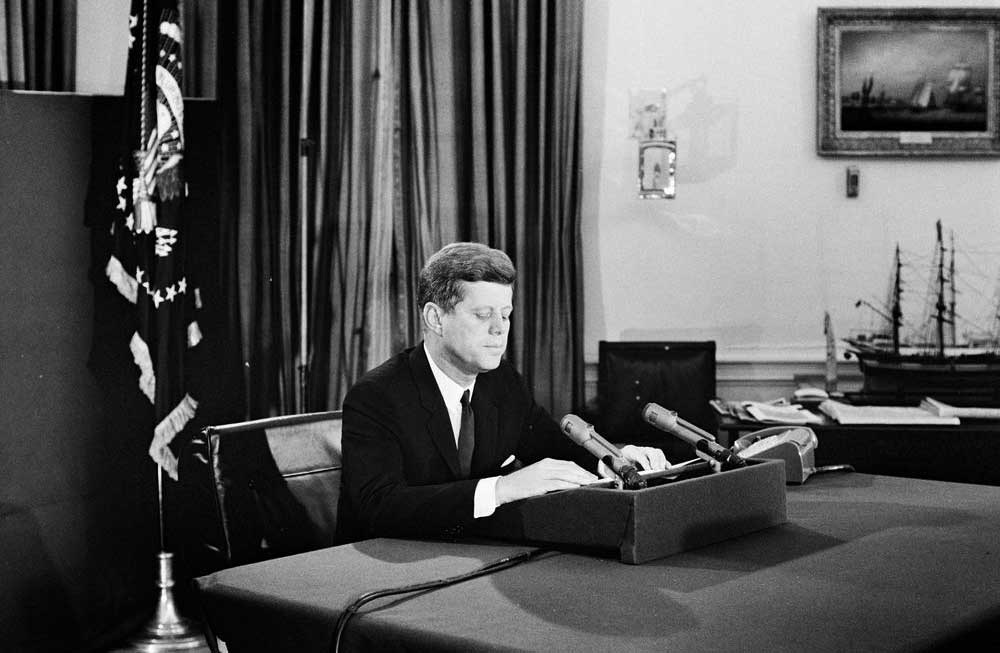
In October of 1962, US intelligence determined that the Soviets were placing medium- range ballistic missiles in Cuba. It was feared that this would upset the balance of power in the world and pose a threat close to US shores. President Kennedy went public with the news, demanding that the Soviets withdraw the missiles from Cuba.
Simultaneously, the Navy was instructed to set up a blockade of Cuba, while the army prepared an invasion force. The Soviets backed down and agreed to remove their missiles from Cuba.
During Kennedy's Administration, the United States first directed its interest to Southeast Asia, in Laos. In July 1962, representatives of the United States and 13 other nations agreed to guarantee the neutrality of Laos. Meanwhile, Communist guerrillas were making consistent progress in taking control of neighboring South Vietnam.
Kennedy dispatched increasing numbers of advisors to South Vietnam, from 1,000 to 16,000 during the Kennedy Administration. However, Kennedy never authorized the dispatching of combat troops to South Vietnam.
During a visit to Dallas in November 1963, Kennedy was assassinated by a gunman while traveling in a motorcade with his wife, Jacqueline. Lee Harvey Oswald was arrested for the crime, but he was killed soon after, and the exact details of Kennedy's assassination remain unknown.