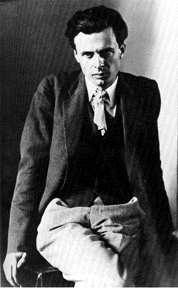
Aldous Huxley was an English writer and thinker best known for his dystopian novel Brave New World, and one of the most wide-ranging intellectuals of his age. Born into a famous family of scientists and writers — grandson of the biologist Thomas Henry Huxley and great-nephew of the poet Matthew Arnold — he was educated at Eton and Oxford, despite an illness that left him nearly blind in his teens.
He made his reputation in the 1920s with brilliant, satirical "novels of ideas" such as Crome Yellow, Antic Hay, and Point Counter Point, which skewered the smart set of postwar England. In 1932 he published Brave New World, a coolly horrifying vision of a future in which humanity is engineered, conditioned, and sedated into contented servitude by technology, consumerism, and the drug "soma." Alongside Orwell's 1984, it became one of the two defining dystopias of the century.
In 1937 Huxley moved to southern California, where he worked as a screenwriter while turning increasingly toward mysticism, Eastern philosophy, and pacifism. His anthology The Perennial Philosophy explored the common ground of the world's religions.
In the 1950s his experiments with the psychedelic drug mescaline produced The Doors of Perception, a meditation on consciousness that made him a guru to the later counterculture and gave the rock band The Doors their name. Suffering from cancer, Huxley died in Los Angeles on November 22, 1963 — the same day President Kennedy was assassinated, a coincidence that overshadowed news of his death.