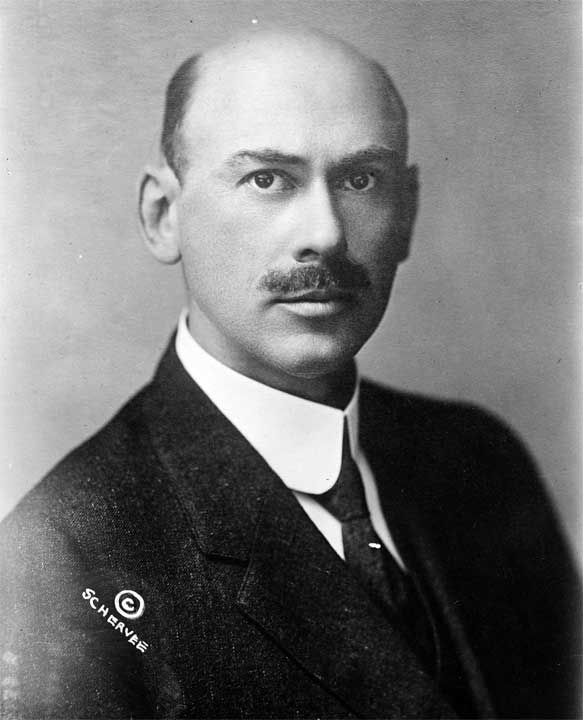
Robert Goddard was the American physicist and inventor widely honored as the "father of modern rocketry," the visionary who built and flew the world's first liquid-fueled rocket and laid the practical foundations of spaceflight. Born in Worcester, Massachusetts, he was inspired as a boy by the science fiction of H. G. Wells and dreamed of building machines that could reach great heights — even, one day, the Moon.
A serious scientist and professor of physics, Goddard worked patiently for decades on the theory and engineering of rocket propulsion. In 1919 he published a landmark paper outlining the principles of rocket flight and suggesting that a rocket might reach the Moon — a notion that drew ridicule from a press that did not understand the physics.
Undeterred, Goddard turned from theory to practice. On March 16, 1926, on a farm in Auburn, Massachusetts, he successfully launched the world's first liquid-fueled rocket, a modest flight that nonetheless opened a new age. Over the following years he developed ever more sophisticated rockets, pioneering gyroscopic guidance, steerable thrust, and fuel-pump systems.
Working in relative obscurity, often short of funds, Goddard accumulated more than two hundred patents covering the essential technologies of the rocket. He died in 1945, before the dawn of the space age he had helped make possible, but the engineers who later sent astronauts into space built on his pioneering work, and NASA named a major space center in his honor.