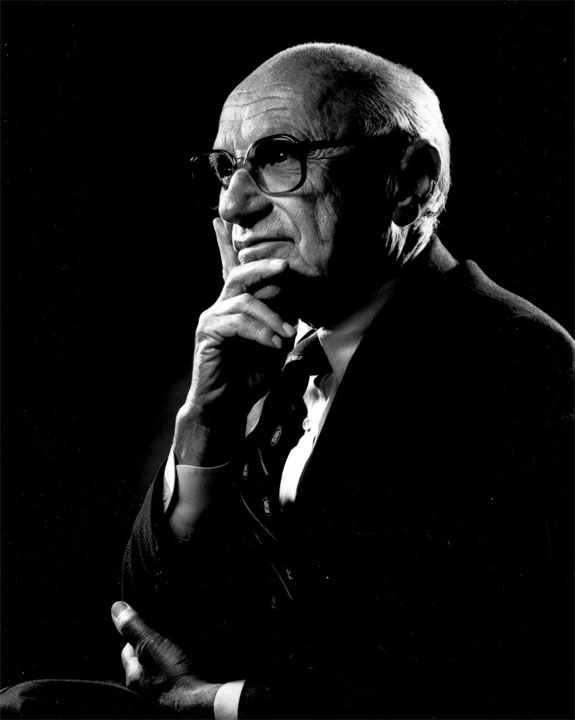
Milton Friedman was one of the most influential economists of the twentieth century, the leading champion of free markets and limited government whose ideas reshaped economic policy across the world. Born in Brooklyn, New York, to poor immigrant parents, he studied economics during the Great Depression and went on to a long and celebrated career, most of it at the University of Chicago, where he became the intellectual leader of the "Chicago School."
Friedman's central contributions concerned the role of money in the economy. Challenging the dominant Keynesian orthodoxy, he argued in his "monetarist" theory that the money supply was the key determinant of inflation and economic stability, and he contended, in an influential history of American monetary policy, that mismanagement of the money supply had turned a recession into the Great Depression.
A passionate defender of individual liberty and economic freedom, he opposed government intervention in the economy and advocated free markets, deregulation, school vouchers, a volunteer army, and a host of other free-market reforms. His popular book Capitalism and Freedom and his television series Free to Choose carried his ideas to a wide public.
Friedman won the Nobel Prize in Economics in 1976, and his influence reached its peak in the 1980s, when leaders such as Ronald Reagan and Margaret Thatcher embraced his free-market philosophy. A brilliant and combative debater, he remained an active and provocative voice in public affairs until his death in 2006.