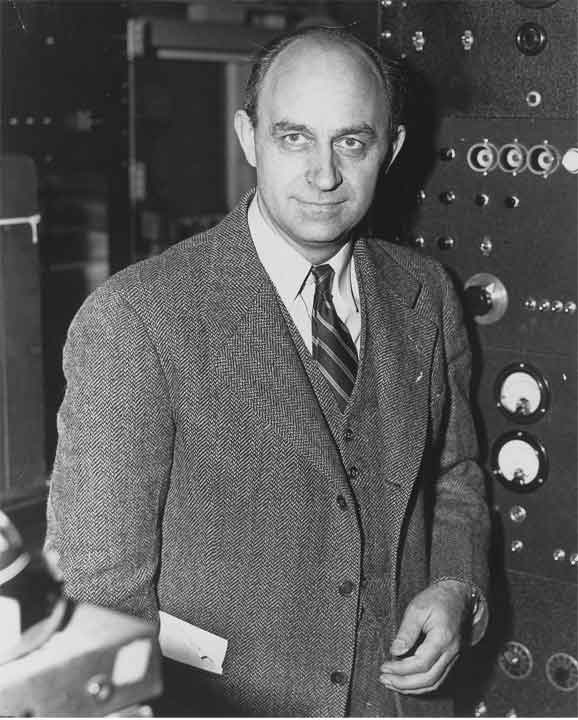
Enrico Fermi was one of the greatest physicists of the twentieth century, a rare master of both theory and experiment whose work helped usher in the nuclear age. Born in Rome, he displayed a prodigious gift for physics from boyhood and emerged as a leading figure in the new science of quantum mechanics, making fundamental contributions to statistical physics and the theory of the atom.
In the 1930s, working in Italy, Fermi pioneered the study of nuclear reactions by bombarding elements with neutrons, work that earned him the Nobel Prize in Physics in 1938. Using the Nobel ceremony in Sweden as his opportunity, he and his Jewish wife fled Fascist Italy and its anti-Semitic laws, emigrating to the United States.
There Fermi played a central role in the Manhattan Project, the wartime effort to build an atomic bomb. On December 2, 1942, beneath the stands of a football stadium at the University of Chicago, he directed the team that achieved the first controlled, self-sustaining nuclear chain reaction — a historic milestone that opened the door to both nuclear weapons and nuclear power.
After the war, Fermi continued his research and became a revered teacher, mentoring a generation of physicists. The element fermium and the national laboratory near Chicago were later named in his honor. He died of cancer in 1954, his name enduring as a synonym for scientific brilliance and versatility.